Back

Collisions & Motion (Momentum & Energy) quiz

Control buttons has been changed to "navigation" mode.
1/15
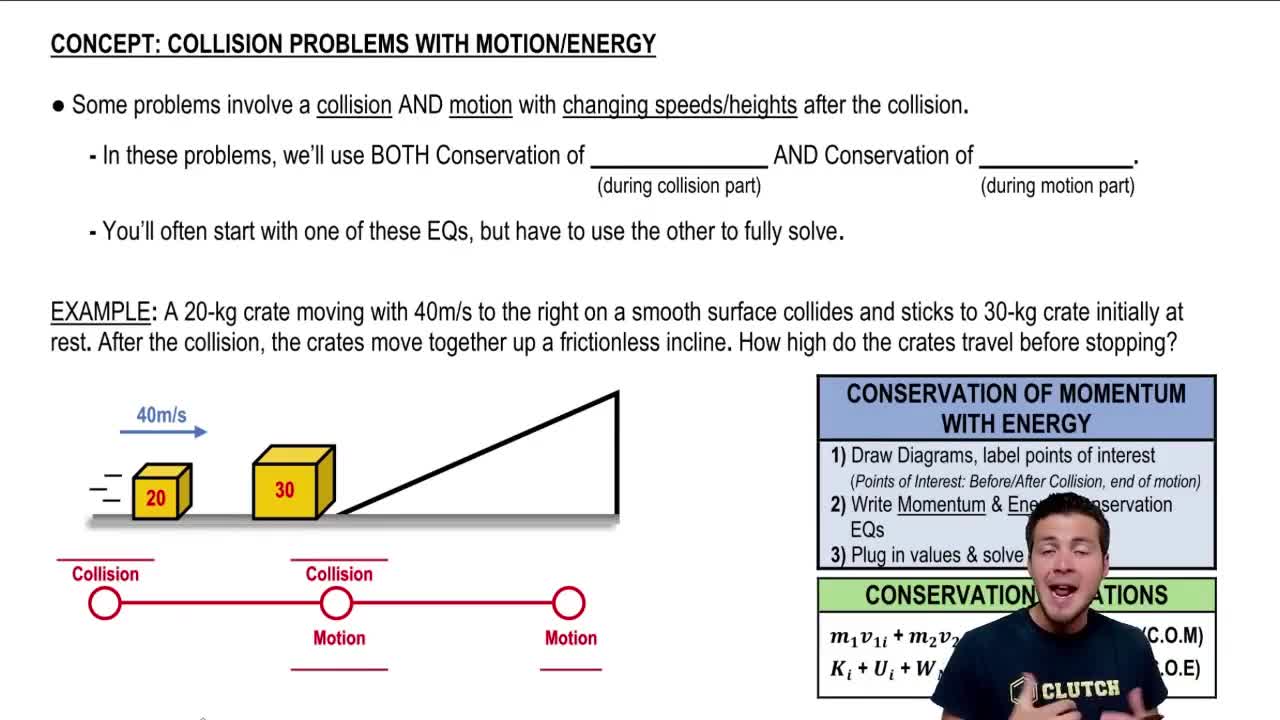
  • What two conservation laws are typically used to solve problems involving collisions followed by motion?

    Conservation of momentum is used for the collision, and conservation of energy is used for the motion after the collision.
  • At which point in the problem do you switch from using conservation of momentum to conservation of energy?

    You switch after the collision, when the objects stick together and start moving as one; this is the start of the motion part.
  • Why is it helpful to label points of interest as A, B, and C in these problems?

    Labeling points as A, B, and C helps avoid confusion between initial and final states in both the collision and motion parts.
  • What does point A represent in the context of a collision and motion problem?

    Point A is right before the collision, just before the two objects interact.
  • What does point B represent in these problems?

    Point B is immediately after the collision, where the objects have stuck together and are about to start moving up the incline.
  • What does point C represent in the step-by-step method?

    Point C is where the motion ends, typically when the objects reach their maximum height and stop moving.
  • Why is energy not conserved during the collision (from A to B) in a completely inelastic collision?

    Energy is not conserved during the collision because some kinetic energy is lost, usually as heat or deformation, when the objects stick together.
  • How do you find the velocity just after the collision (at point B)?

    You use the conservation of momentum equation, setting the total momentum before the collision equal to the total momentum after.
  • Why do the masses of the crates cancel out when solving for the height they reach after the collision?

    The masses cancel because both sides of the energy equation include the combined mass, allowing it to be divided out.
  • What is the expression for the maximum height (y_c) the crates reach after the collision?

    The maximum height y_c is given by v_b squared divided by 2g, or y_c = v_b^2 / (2g).
  • Why does the angle of the incline not affect the final height reached in this problem?

    The potential energy depends only on the vertical height, not the angle, so the incline's angle does not factor into the calculation.
  • When is it valid to use conservation of energy after a collision?

    It is valid when there is no work done by non-conservative forces like friction or external work after the collision.
  • What type of collision occurs when two objects stick together after colliding?

    This is called a completely inelastic collision.
  • What should you do if you get stuck solving for a variable in one conservation equation?

    Switch to the other conservation equation (momentum or energy) to solve for the unknown variable, then substitute back.
  • What are some variations of collision and motion problems you might encounter?

    Variations include collisions followed by motion up a spring, with friction, or swinging like a pendulum, but the same step-by-step approach applies.