Skip to main content
Physics with Calculus
My Course
Learn
Exam Prep
AI Tutor
Study Guides
Textbook Solutions
Flashcards
Explore
Try the app
My Course
Learn
Exam Prep
AI Tutor
Study Guides
Textbook Solutions
Flashcards
Explore
Try the app
Back
Circular Motion of Charges in Magnetic Fields quiz
You can tap to flip the card.
Why do charges moving through a magnetic field experience circular motion?
You can tap to flip the card.
👆
Why do charges moving through a magnetic field experience circular motion?
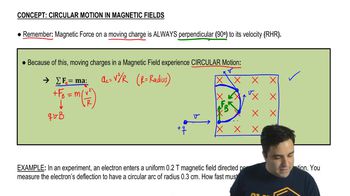
Because the magnetic force is always perpendicular to the velocity of the charge, causing it to move in a circle.
Track progress
Control buttons has been changed to "navigation" mode.
1/15
Related flashcards
Related practice
Recommended videos
Circular Motion of Charges in Magnetic Fields definitions
Circular Motion of Charges in Magnetic Fields
15 Terms
Circular Motion of Charges in Magnetic Fields
28. Magnetic Fields and Forces
4 problems
Topic
Patrick
Mass Spectrometer
28. Magnetic Fields and Forces
3 problems
Topic
David-Paige
28. Magnetic Fields and Forces
7 topics
11 problems
Chapter
Patrick
Guided course
11:33
Circular Motion of Charges in Magnetic Fields
5
views
Terms in this set (15)
Hide definitions
Why do charges moving through a magnetic field experience circular motion?
Because the magnetic force is always perpendicular to the velocity of the charge, causing it to move in a circle.
What rule helps determine the direction of the magnetic force on a moving charge?
The right-hand rule helps determine the direction of the magnetic force.
What is the equation for the radius of the circular path of a charge in a magnetic field?
The equation is R = mv/qB, where R is radius, m is mass, v is velocity, q is charge, and B is magnetic field strength.
What does the magnetic force act as in the context of circular motion?
The magnetic force acts as the centripetal force that keeps the charge moving in a circle.
If a charge moves parallel to the magnetic field, what is the resulting force and motion?
There is no magnetic force, so the charge moves in a straight line.
What type of motion occurs if a charge moves at an angle to the magnetic field?
The charge undergoes helical motion, spiraling along the direction of the field.
Why is the work done by the magnetic force on a charge moving in a circle zero?
Because the magnetic force is always perpendicular to the displacement, making the work done zero.
How do you calculate the velocity of a charge given the radius, charge, magnetic field, and mass?
Use v = r q B / m, rearranging the radius equation to solve for velocity.
When using the equation R = mv/qB, should you use the sign of the charge?
No, you use the absolute value of the charge; the sign only affects the direction, not the magnitude.
What is the value of the sine of the angle when the velocity is perpendicular to the magnetic field?
The sine of 90 degrees is 1, so the force is maximized.
What is the centripetal acceleration formula used in this context?
Centripetal acceleration is a = v^2 / r.
What happens to the direction of the magnetic force as the charge moves in a circle?
The direction of the magnetic force continuously changes to remain perpendicular to the velocity.
What is the physical meaning of the equation F = qvB in this context?
It gives the magnitude of the magnetic force on a charge moving perpendicular to a magnetic field.
What is a quick way to check if your calculated velocity for a charge is reasonable?
Ensure the velocity is less than the speed of light (3 x 10^8 m/s).
What is the effect of the angle between velocity and magnetic field on the magnetic force?
The force is proportional to the sine of the angle; it is maximum at 90° and zero at 0°.
 BackBack

 11:33
11:33