- Download the worksheet to save time writing
- Start solving the practice problems
- If you're stuck, watch the video solutions
- See your summary to get more insights

A box weighing 10 N rests on a horizontal table. A lightweight cord attached to the box passes through a cylindrical pulley with a mass of 1 kg and a diameter of 18 cm. A 6 N weight is suspended from the other end of the cord as shown in the image. After the system is released, determine the acceleration of the box.

A jewelry box of mass 1 kg is attached to the end of a thin string. The string is wound around a solid, uniform disk of mass 6 kg and radius 10 cm. The disk rotates about a fixed axis that passes through its center. What is the speed of the box right before hitting the ground if the box is released from rest from a height of 1m above the ground?
A Buddhist monk is holding a hand-held prayer wheel. A small metal ball of 0.20 kg is attached to the head of the prayer wheel by a string of length 0.19 m. The monk starts to move the prayer wheel which makes the metal ball move in a horizontal circle, accelerating it to a rotational speed of 66 rpm in 5.5 s from rest. Determine the magnitude and origin of the torque on the small ball.
A 55 kg athlete preparing to dive stands at the end of a homogenous horizontal diving board of mass 38 kg. The diving board is 6.0 m long. The other end is anchored through a screw to the diving tower. Calculate the magnitude of the torque exerted by the athlete and the board about the screw.
A thin rod is free to rotate about point O. Point O is considered the origin of the x-y plane. The point of application of the force is located at x = 1.5 m, y = 1 m. If the force has a magnitude of 80.0 N and is directed 30º north of east, determine the net torque about O.
A sphere placed in a Cartesian frame at the position (1.5 m, 2.5 m, 0) is subject to a force F= -3 î N. Find the torque produced by F about the point O (0, 0, 0).
How can a 59-kg cyclist exert more torque while ascending a slope if he puts all his weight on each pedal? Given the pedals move in a circular path with a radius of 18 cm.
The motor of a hand-held sander machine applies a steady torque τ to the disk, enhancing its angular velocity by 1.5 rad/s each second. The moment of inertia of the disk is 3.0 kg•m2. Calculate the torque τ.
A very light bar of length 0.80 m has two cubes of mass 0.25 kg and 0.75 kg welded to its two ends. The bar attached at its center of mass to a fan motor revolves counterclockwise at a steady angular speed of 45 rpm. A torque τ applied to the bar causes it to stop rotating in 12 s. Calculate τ.
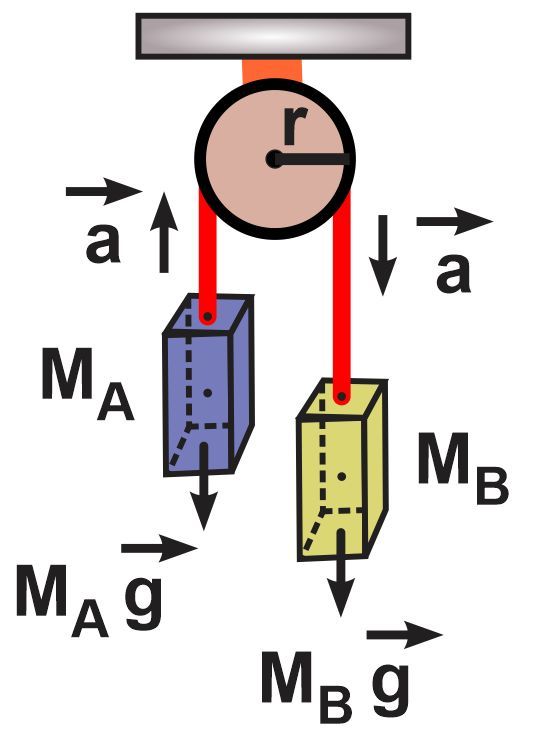
A building employs a dual counterweight system with two elevator cars. Elevator Car A has a mass of 1200 kg and starts at the tenth floor. Elevator Car B, with a mass of 1250 kg, begins at the second floor. They are connected by a steel cable that runs over a pulley that is free to rotate about a fixed axis at the top of the shaft. The pulley is a solid cylinder with a radius of 0.80 meters and a mass of 100 kg. Find the acceleration of each elevator car as they move in the shaft.
What is a major advantage of using energy methods over motion equations in dynamics problems?
Under which condition would motion equations be necessary to solve for the time of an object's motion?
What is a key difference between using torque methods and energy methods in rotational problems?