- Download the worksheet to save time writing
- Start solving the practice problems
- If you're stuck, watch the video solutions
- See your summary to get more insights

What is the point in a projectile's trajectory where its vertical velocity is zero?
A 5 kg object slides down a frictionless hill from a height of 10 m. What is its speed at the bottom?
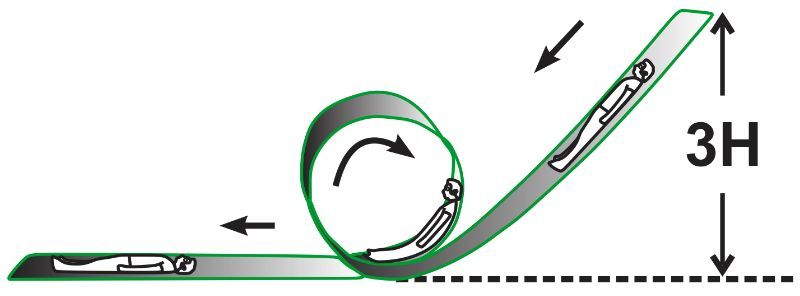
An engineer is designing a water slide. He thinks of making it a "looping water slide". The sliders are to be on the slide path at all points throughout their trajectories. He calculates the minimum height from which the sliders should be released to be H = 2.5R, where R is the loop radius. In reality, the actual release height would be equal to 3H. Calculate the normal force exerted on a slider of mass M when it is at the bottom of the loop as shown in the figure. (Ignore friction)
A roller coaster starts from rest at the top of a hill of height 50 meters. What is its speed at the bottom, assuming no friction?
Which type of work is done by friction when an object moves along a smooth surface?
At which point in a pendulum's swing is its kinetic energy the greatest?
A pendulum swings to a maximum angle of 45° with a length of 3 m. What is the horizontal displacement from the center?
If a pendulum's length is doubled, how does this affect the maximum height it can reach if released from the same angle?
A potential energy graph has positive slope at m. What is the direction of the force there?
For J, what is the force at m?
A model potential for motion along a track is , where and are constants. Which expression gives the force and correctly identifies the role of ?