

Ch 12: Rotation of a Rigid Body
Knight Calc - Physics for Scientists and Engineers 5th Edition
Knight Calc5th EditionPhysics for Scientists and EngineersISBN: 9780137344796Not the one you use?Change textbook
Chapter 12, Problem 77a

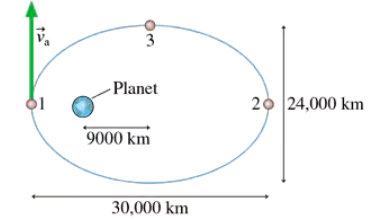
A satellite follows the elliptical orbit shown in FIGURE P12.77. The only force on the satellite is the gravitational attraction of the planet. The satellite's speed at point 1 is 8000 m/s. Does the satellite experience any torque about the center of the planet? Explain.

Verified step by step guidance
1
Step 1: Recall the definition of torque. Torque (τ) is given by the equation: τ = r × F, where r is the position vector from the axis of rotation (in this case, the center of the planet) to the point of application of the force, and F is the force acting on the object.
Step 2: Identify the force acting on the satellite. The only force acting on the satellite is the gravitational force, which always points directly toward the center of the planet. This means the force vector is radial.
Step 3: Analyze the direction of the position vector and the force vector. The position vector r also points from the center of the planet to the satellite, which is in the same direction as the gravitational force vector.
Step 4: Apply the cross product condition for torque. The torque is determined by the cross product of r and F. Since the position vector and the force vector are parallel (or anti-parallel), the angle between them is 0° (or 180°), and the sine of this angle is 0. Therefore, the torque is zero: τ = r × F = 0.
Step 5: Conclude that the satellite does not experience any torque about the center of the planet. This is because the gravitational force acts along the radial direction, and there is no perpendicular component of the force to create a torque.

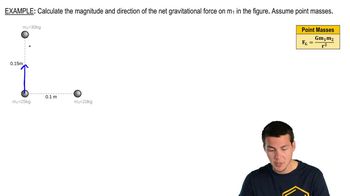
Verified video answer for a similar problem:

This video solution was recommended by our tutors as helpful for the problem above.
Video duration:
3m
Was this helpful?

Key Concepts

Here are the essential concepts you must grasp in order to answer the question correctly.

Torque

Torque is a measure of the rotational force acting on an object, defined as the product of the force applied and the distance from the pivot point (lever arm). In the context of a satellite orbiting a planet, torque is relevant when considering how forces can cause an object to rotate about a point. If the force acts directly through the center of mass, the torque is zero, meaning no rotational effect is produced.
Recommended video:
Guided course
08:55
Net Torque & Sign of Torque

Gravitational Force

Gravitational force is the attractive force between two masses, described by Newton's law of universal gravitation. For a satellite in orbit, this force is directed towards the center of the planet and is responsible for keeping the satellite in its elliptical path. The gravitational force does not create torque if it acts through the center of the planet, as there is no lever arm to produce rotation.
Recommended video:
Guided course
05:41
Gravitational Forces in 2D

Elliptical Orbits

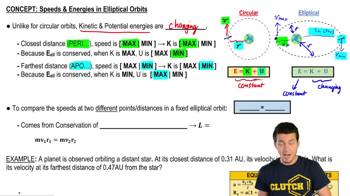
Elliptical orbits are paths followed by objects in space where the orbiting body moves around a central mass in an elongated circle. According to Kepler's laws, the satellite's speed varies at different points in the orbit, but the gravitational force remains the only force acting on it. Understanding the nature of elliptical orbits helps clarify why the satellite does not experience torque, as the gravitational force acts along the radius of the orbit.
Recommended video:
Guided course
6:03
Speed and Energy of Elliptical Orbits
Related Practice
Textbook Question

A long, thin rod of mass M and length L is standing straight up on a table. Its lower end rotates on a frictionless pivot. A very slight push causes the rod to fall over. As it hits the table, what are the speed of the tip of the rod?

3
views
Textbook Question

A 10 g bullet traveling at 400 m/s strikes a 10 kg, 1.0-m-wide door at the edge opposite the hinge. The bullet embeds itself in the door, causing the door to swing open. What is the angular velocity of the door just after impact?

1
views
Textbook Question

The sphere of mass M and radius R in FIGURE P12.75 is rigidly attached to a thin rod of radius r that passes through the sphere at distance (1/2)R from the center. A string wrapped around the rod pulls with tension T. Find an expression for the sphere's angular acceleration. The rod's moment of inertia is negligible.

3
views
Textbook Question

A merry-go-round is a common piece of playground equipment. A 3.0-m-diameter merry-go-round with a mass of 250 kg is spinning at 20 rpm. John runs tangent to the merry-go-round at 5.0 m/s, in the same direction that it is turning, and jumps onto the outer edge. John's mass is 30 kg. What is the merry-go-round's angular velocity, in rpm, after John jumps on?

2
views
Textbook Question

A long, thin rod of mass M and length L is standing straight up on a table. Its lower end rotates on a frictionless pivot. A very slight push causes the rod to fall over. As it hits the table, what are the angular velocity

2
views
Textbook Question

A satellite follows the elliptical orbit shown in FIGURE P12.77. The only force on the satellite is the gravitational attraction of the planet. The satellite's speed at point 1 is 8000 m/s. What is the satellite's speed at point 2?

1
views