
Ch 27: Magnetic Field and Magnetic Forces
Young & Freedman Calc - University Physics 14th Edition
Young & Freedman Calc14th EditionUniversity PhysicsISBN: 9780321973610Not the one you use?Change textbook
Chapter 27, Problem 37

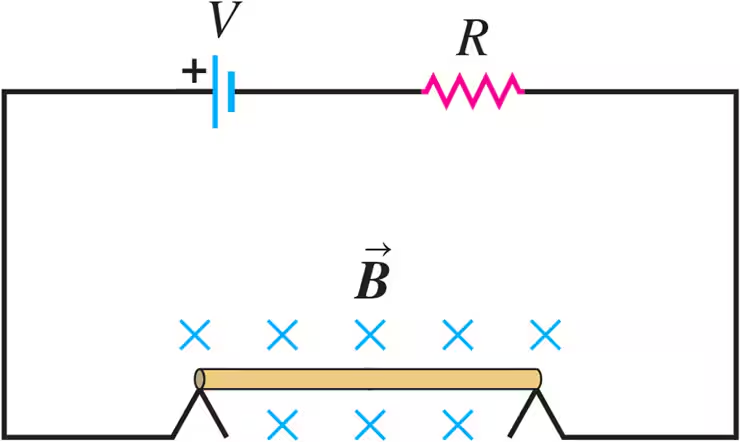
A thin, 50.0 cm long metal bar with mass 750 g rests on, but is not attached to, two metallic supports in a uniform 0.450 T magnetic field, as shown in Fig. E27.37. A battery and a 25.0 Ω resistor in series are connected to the supports. (a) What is the highest voltage the battery can have without breaking the circuit at the supports? (b) The battery voltage has the maximum value calculated in part (a). If the resistor suddenly gets partially short-circuited, decreasing its resistance to 2.00 Ω, find the initial acceleration of the bar.

Verified step by step guidance
1
Step 1: Begin by analyzing the forces acting on the metal bar. The magnetic force can be calculated using the formula \( F = I \cdot L \cdot B \), where \( I \) is the current, \( L \) is the length of the bar, and \( B \) is the magnetic field strength.
Step 2: To find the current \( I \), use Ohm's Law \( V = I \cdot R \), where \( V \) is the voltage of the battery and \( R \) is the resistance. Rearrange to find \( I = \frac{V}{R} \).
Step 3: Substitute the expression for \( I \) from Step 2 into the magnetic force equation from Step 1 to get \( F = \frac{V}{R} \cdot L \cdot B \).
Step 4: For part (a), the force \( F \) must not exceed the gravitational force \( F_g = m \cdot g \) acting on the bar, where \( m \) is the mass of the bar and \( g \) is the acceleration due to gravity. Set \( F = F_g \) and solve for \( V \) to find the maximum voltage.
Step 5: For part (b), once the resistance decreases to 2.00-ohm, recalculate the current using \( I = \frac{V}{2.00} \). Use this new current to find the new magnetic force \( F \). Then, apply Newton's second law \( F = m \cdot a \) to find the initial acceleration \( a \) of the bar.

Verified video answer for a similar problem:

This video solution was recommended by our tutors as helpful for the problem above.
Video duration:
8m
Was this helpful?

Key Concepts

Here are the essential concepts you must grasp in order to answer the question correctly.

Magnetic Force on a Current-Carrying Conductor

When a current-carrying conductor is placed in a magnetic field, it experiences a force given by F = I * L * B * sin(θ), where I is the current, L is the length of the conductor, B is the magnetic field strength, and θ is the angle between the current direction and the magnetic field. In this scenario, the force can cause the bar to move if it exceeds the frictional force at the supports.
Recommended video:
Guided course
09:57
Magnetic Force on Current-Carrying Wire

Ohm's Law and Circuit Analysis

Ohm's Law states that V = I * R, where V is the voltage, I is the current, and R is the resistance. In a series circuit, the total resistance is the sum of individual resistances. Understanding how changes in resistance affect current and voltage is crucial for determining the maximum voltage the battery can supply without causing excessive current that might break the circuit.
Recommended video:
Guided course
03:07
Resistance and Ohm's Law

Newton's Second Law of Motion

Newton's Second Law states that the acceleration of an object is directly proportional to the net force acting on it and inversely proportional to its mass (F = m * a). In this problem, once the resistance changes, the resulting change in current alters the magnetic force on the bar, affecting its acceleration. Calculating this acceleration requires understanding the relationship between force, mass, and acceleration.
Recommended video:
Guided course
06:54
Intro to Forces & Newton's Second Law
Related Practice
Textbook Question

A straight, 2.5 m wire carries a typical household current of 1.5 A (in one direction) at a location where the earth's magnetic field is 0.55 gauss from south to north. Find the magnitude and direction of the force that our planet's magnetic field exerts on this wire if it is oriented so that the current in it is running (a) from west to east, (b) vertically upward, (c) from north to south. (d) Is the magnetic force ever large enough to cause significant effects under normal household conditions?

1
views
Textbook Question

A straight, vertical wire carries a current of 2.60 A downward in a region between the poles of a large superconducting electromagnet, where the magnetic field has magnitude B = 0.588 T and is horizontal. What are the magnitude and direction of the magnetic force on a 1.00 cm section of the wire that is in this uniform magnetic field, if the magnetic field direction is (a) east?

1
views
Textbook Question

Figure E27.49 shows a portion of a silver ribbon with z1 = 11.8 mm and y1 = 0.23 mm, carrying a current of 120 A in the +x-direction. The ribbon lies in a uniform magnetic field, in the y-direction, with magnitude 0.95 T. Apply the simplified model of the Hall effect presented in Section 27.9. If there are 5.85 x 1028 free electrons per cubic meter, find (a) the magnitude of the drift velocity of the electrons in the x-direction; (b) the magnitude and direction of the electric field in the z-direction due to the Hall effect; (c) the Hall emf.

Textbook Question

Singly ionized (one electron removed) atoms are accelerated and then passed through a velocity selector consisting of perpendicular electric and magnetic fields. The electric field is 155 V/m and the magnetic field is 0.0315 T. The ions next enter a uniform magnetic field of magnitude 0.0175 T that is oriented perpendicular to their velocity. (a) How fast are the ions moving when they emerge from the velocity selector? (b) If the radius of the path of the ions in the second magnetic field is 17.5 cm, what is their mass?

3
views
Textbook Question

A long wire carrying 4.50 A of current makes two 90° bends, as shown in Fig. E27.35. The bent part of the wire passes through a uniform 0.240 T magnetic field directed as shown in the figure and confined to a limited region of space. Find the magnitude and direction of the force that the magnetic field exerts on the wire.

1
views