Ch 06: Dynamics I: Motion Along a Line
Knight Calc - Physics for Scientists and Engineers 5th Edition
Knight Calc5th EditionPhysics for Scientists and EngineersISBN: 9780137344796Not the one you use?Change textbook
Chapter 6, Problem 49b

Sam, whose mass is 75 kg, takes off across level snow on his jet-powered skis. The skis have a thrust of 200 N and a coefficient of kinetic friction on snow of 0.10. Unfortunately, the skis run out of fuel after only 10 s. How far has Sam traveled when he finally coasts to a stop?

Verified step by step guidance
1
Determine the net force acting on Sam while the skis are powered. The net force is given by: Fnet = Fthrust - Ffriction, where Ffriction = μkmg. Substitute the given values to calculate the net force.
Use Newton's second law to find the acceleration while the skis are powered: a = Fnetm. Substitute the net force and Sam's mass to calculate the acceleration.
Determine the distance traveled during the powered motion using the kinematic equation: dpowered = vit + 12at2. Here, vi is the initial velocity (0 m/s), t is the time (10 s), and a is the acceleration calculated in the previous step.
Find the velocity at the end of the powered motion using the kinematic equation: vf = vi + at. This velocity will be the initial velocity for the coasting phase.
Determine the distance traveled during the coasting phase. First, calculate the deceleration due to friction: acoast = -Ffrictionm. Then, use the kinematic equation: dcoast = vf22acoast. Add the distances from the powered and coasting phases to find the total distance traveled.

Verified video answer for a similar problem:

This video solution was recommended by our tutors as helpful for the problem above.
Was this helpful?

Key Concepts

Here are the essential concepts you must grasp in order to answer the question correctly.

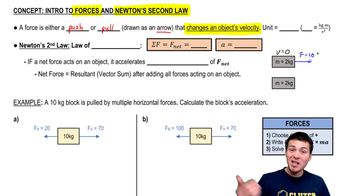
Newton's Second Law of Motion

Newton's Second Law states that the acceleration of an object is directly proportional to the net force acting on it and inversely proportional to its mass. This principle can be expressed with the formula F = ma, where F is the net force, m is mass, and a is acceleration. In this scenario, understanding how to calculate the net force acting on Sam is crucial for determining his acceleration while the skis are powered.
Recommended video:
Guided course
06:54
Intro to Forces & Newton's Second Law

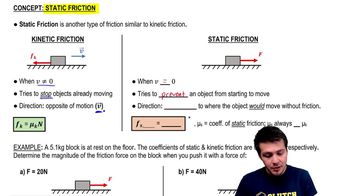
Friction

Friction is the force that opposes the relative motion of two surfaces in contact. The coefficient of kinetic friction quantifies this force and is used to calculate the frictional force acting on Sam's skis as he moves across the snow. In this case, the frictional force will affect the deceleration of Sam once the thrust from the skis ceases, ultimately influencing how far he travels before coming to a stop.
Recommended video:
Guided course
08:11
Static Friction & Equilibrium

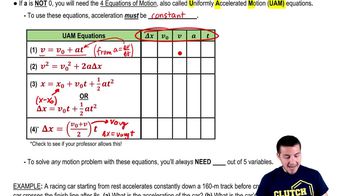
Kinematic Equations

Kinematic equations describe the motion of objects under constant acceleration. These equations relate displacement, initial velocity, final velocity, acceleration, and time. In this problem, after determining the acceleration due to thrust and friction, kinematic equations can be used to calculate the distance Sam travels during the powered phase and the coasting phase until he stops.
Recommended video:
Guided course
08:25
Kinematics Equations