
Ch 10: Dynamics of Rotational Motion
Young & Freedman Calc - University Physics 14th Edition
Young & Freedman Calc14th EditionUniversity PhysicsISBN: 9780321973610Not the one you use?Change textbook
Chapter 10, Problem 40b

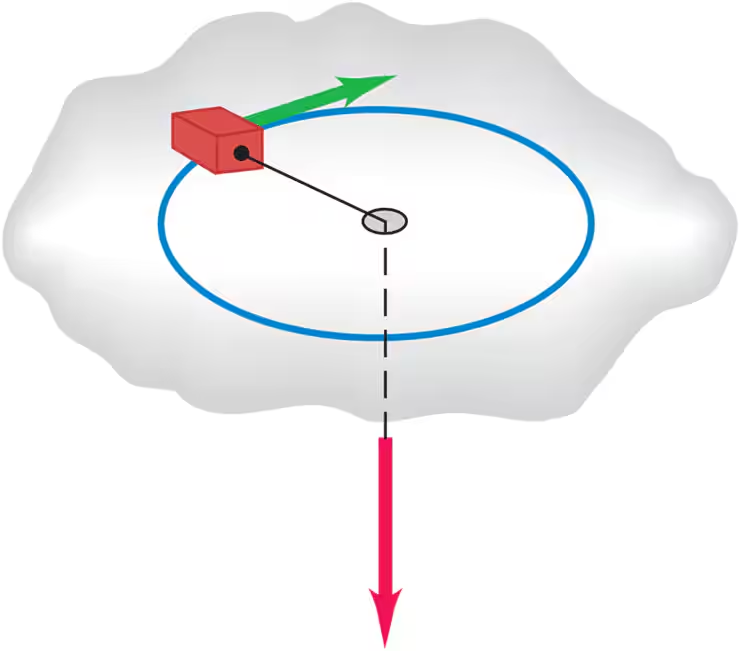
A small block on a frictionless, horizontal surface has a mass of 0.0250 kg. It is attached to a massless cord passing through a hole in the surface (Fig. E10.40). The block is originally revolving at a distance of 0.300 m from the hole with an angular speed of 2.85 rad/s. The cord is then pulled from below, shortening the radius of the circle in which the block revolves to 0.150 m. Model the block as a particle. What is the new angular speed?

Verified step by step guidance
1
Identify the principle of conservation of angular momentum, which states that if no external torque acts on a system, the angular momentum of the system remains constant.
Write the expression for angular momentum L of the block: L = I * ω, where I is the moment of inertia and ω is the angular speed.
For a point mass m at a distance r from the axis of rotation, the moment of inertia I is given by I = m * r^2.
Set up the equation for conservation of angular momentum: m * r1^2 * ω1 = m * r2^2 * ω2, where r1 and ω1 are the initial radius and angular speed, and r2 and ω2 are the final radius and angular speed.
Solve for the new angular speed ω2: ω2 = (r1^2 * ω1) / r2^2. Substitute the given values: r1 = 0.300 m, ω1 = 2.85 rad/s, and r2 = 0.150 m to find ω2.

Verified video answer for a similar problem:

This video solution was recommended by our tutors as helpful for the problem above.
Video duration:
5m
Was this helpful?

Key Concepts

Here are the essential concepts you must grasp in order to answer the question correctly.

Conservation of Angular Momentum

In a closed system with no external torques, the angular momentum remains constant. For a particle moving in a circle, angular momentum L is given by L = Iω, where I is the moment of inertia and ω is the angular speed. When the radius changes, the moment of inertia changes, but the product Iω remains constant, allowing us to solve for the new angular speed.
Recommended video:
Guided course
12:12
Conservation of Angular Momentum

Moment of Inertia for a Point Mass

The moment of inertia (I) for a point mass revolving around an axis is calculated as I = mr², where m is the mass and r is the radius of the circle. This concept is crucial for understanding how changes in the radius affect the angular momentum and, consequently, the angular speed of the block.
Recommended video:
Guided course
03:42
Moment of Inertia & Mass Distribution

Relationship Between Radius and Angular Speed

As the radius of rotation decreases, the angular speed must increase to conserve angular momentum, assuming no external torques. This inverse relationship is derived from the conservation principle, where the initial and final angular momenta (I₁ω₁ = I₂ω₂) are equal, allowing us to calculate the new angular speed when the radius changes.
Recommended video:
Guided course
03:43
Relationships Between Force, Field, Energy, Potential
Related Practice
Textbook Question

A small block on a frictionless, horizontal surface has a mass of 0.0250 kg. It is attached to a massless cord passing through a hole in the surface (Fig. E10.40). The block is originally revolving at a distance of 0.300 m from the hole with an angular speed of 2.85 rad/s. The cord is then pulled from below, shortening the radius of the circle in which the block revolves to 0.150 m. Model the block as a particle. Find the change in kinetic energy of the block.

3
views
Textbook Question

Under some circumstances, a star can collapse into an extremely dense object made mostly of neutrons and called a neutron star. The density of a neutron star is roughly 101410^{14} times as great as that of ordinary solid matter. Suppose we represent the star as a uniform, solid, rigid sphere, both before and after the collapse. The star's initial radius was 7.0×10⁵ km7.0\(\times\)10^5\(\text{ km}\) (comparable to our sun); its final radius is 16 km. If the original star rotated once in 3030 days, find the angular speed of the neutron star.

2
views
Textbook Question

A small block on a frictionless, horizontal surface has a mass of 0.0250 kg. It is attached to a massless cord passing through a hole in the surface (Fig. E10.40). The block is originally revolving at a distance of 0.300 m from the hole with an angular speed of 2.85 rad/s. The cord is then pulled from below, shortening the radius of the circle in which the block revolves to 0.150 m. Model the block as a particle. How much work was done in pulling the cord?

4
views
Textbook Question

Calculate the magnitude of the angular momentum of the earth in a circular orbit around the sun. Is it reasonable to model it as a particle? Consult Appendix E and the astronomical data in Appendix F

3
views
Textbook Question

A hollow, thin-walled sphere of mass 12.0kg12.0\(\operatorname{kg}\) and diameter 48.0 cm48.0\(\text{ cm}\) is rotating about an axle through its center. The angle (in radians) through which it turns as a function of time (in seconds) is given by θ(t)=At2+Bt4θ(t) = At^2 + Bt^4, where A has numerical value 1.501.50 and B has numerical value 1.101.10. What are the units of the constants A and B?

1
views
Textbook Question

A small block on a frictionless, horizontal surface has a mass of 0.0250 kg. It is attached to a massless cord passing through a hole in the surface (Fig. E10.40). The block is originally revolving at a distance of 0.300 m from the hole with an angular speed of 2.85 rad/s. The cord is then pulled from below, shortening the radius of the circle in which the block revolves to 0.150 m. Model the block as a particle. Is the angular momentum of the block conserved? Why or why not?

1
views