Ch 13: Newton's Theory of Gravity
Knight Calc - Physics for Scientists and Engineers 5th Edition
Knight Calc5th EditionPhysics for Scientists and EngineersISBN: 9780137344796Not the one you use?Change textbook
Chapter 13, Problem 70c

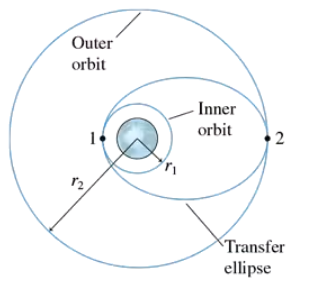
Let's look in more detail at how a satellite is moved from one circular orbit to another. FIGURE CP13.70 shows two circular orbits, of radii r1 and r2, and an elliptical orbit that connects them. Points 1 and 2 are at the ends of the semimajor axis of the ellipse. How much work must the rocket motor do to transfer the satellite from the circular orbit to the elliptical orbit?

Verified step by step guidance
1
Step 1: Understand the problem. The satellite is initially in a circular orbit of radius r1 and needs to be transferred to an elliptical orbit that connects to another circular orbit of radius r2. The work done by the rocket motor corresponds to the change in the satellite's mechanical energy during this transfer.
Step 2: Recall the formula for mechanical energy in an orbit. The total mechanical energy (E) of a satellite in orbit is the sum of its kinetic energy (K) and gravitational potential energy (U). For a circular orbit, E = -GMm/(2r), where G is the gravitational constant, M is the mass of the central body, m is the mass of the satellite, and r is the radius of the orbit.
Step 3: Calculate the mechanical energy in the initial circular orbit. Use the formula E_initial = -GMm/(2r1) to find the total energy of the satellite in the inner circular orbit.
Step 4: Calculate the mechanical energy in the elliptical orbit. For an elliptical orbit, the total mechanical energy is given by E_ellipse = -GMm/(2a), where a is the semi-major axis of the ellipse. Determine the value of a using the radii r1 and r2: a = (r1 + r2)/2.
Step 5: Find the work done by the rocket motor. The work required to transfer the satellite is equal to the change in mechanical energy: Work = E_ellipse - E_initial. Substitute the expressions for E_ellipse and E_initial to compute the work done.

Verified video answer for a similar problem:

This video solution was recommended by our tutors as helpful for the problem above.
Was this helpful?

Key Concepts

Here are the essential concepts you must grasp in order to answer the question correctly.

Work-Energy Principle

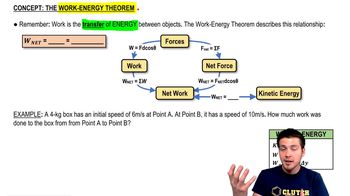
The Work-Energy Principle states that the work done on an object is equal to the change in its kinetic energy. In the context of moving a satellite between orbits, the work done by the rocket motor must account for the difference in gravitational potential energy and kinetic energy between the initial and final orbits.
Recommended video:
Guided course
04:10
The Work-Energy Theorem

Gravitational Potential Energy

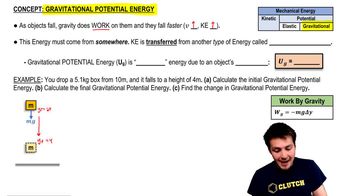
Gravitational potential energy (U) is the energy an object possesses due to its position in a gravitational field. For a satellite in orbit, this energy depends on its distance from the central body. The change in gravitational potential energy when moving between two orbits is crucial for calculating the work required for the transfer.
Recommended video:
Guided course
06:35
Gravitational Potential Energy

Elliptical Orbits and Hohmann Transfer

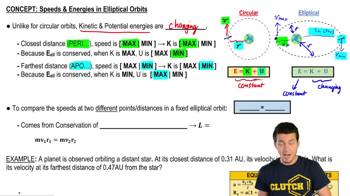
An elliptical orbit connects two circular orbits in a maneuver known as a Hohmann transfer. This method involves two engine burns: one to enter the elliptical orbit and another to circularize at the destination. Understanding the geometry of these orbits is essential for determining the work needed to transition between them.
Recommended video:
Guided course
6:03
Speed and Energy of Elliptical Orbits
Related Practice
Textbook Question

FIGURE CP13.71 shows a particle of mass m at distance š“ from the center of a very thin cylinder of mass M and length L. The particle is outside the cylinder, so š“ > L/2 . Calculate the gravitational potential energy of these two masses.

1
views
Textbook Question

While visiting Planet Physics, you toss a rock straight up at 11 m/s and catch it 2.5 s later. While you visit the surface, your cruise ship orbits at an altitude equal to the planet's radius every 230 min. What are the (a) mass and (b) radius of Planet Physics?

1
views
Textbook Question

A satellite in a circular orbit of radius r has period T. A satellite in a nearby orbit with radius r + Ī”r, where Ī”r ≪ r, has the very slightly different period T + Ī”T. Show that Ī”T/T = (3/2) (Ī”r/r)

1
views
Textbook Question

Let’s look in more detail at how a satellite is moved from one circular orbit to another. FIGURE CP13.70 shows two circular orbits, of radii r1 and r2, and an elliptical orbit that connects them. Points 1 and 2 are at the ends of the semimajor axis of the ellipse. Consider a 1000 kg communications satellite that needs to be boosted from an orbit 300 km above the earth to a geosynchronous orbit 35,900 km above the earth. Find the velocity v'1 on the inner circular orbit and the velocity v'1 at the low point on the elliptical orbit that spans the two circular orbits.

Textbook Question

September 2015 saw the historic discovery of gravitational waves, almost exactly 100 years after Einstein predicted their existence as a consequence of his theory of general relativity. Gravitational waves are a literal stretching and compressing of the fabric of space. Even the most sensitive instruments—capable of sensing that the path of a 4-km-long laser beam has lengthened by one-thousandth the diameter of a proton—can detect waves created by only the most extreme cosmic events. The first detection was due to the collision of two black holes more than 750 million light years from earth. Although a full description of gravitational waves requires knowledge of Einstein's general relativity, a surprising amount can be understood with the physics you've already learned. Two black holes collide and merge when their Schwarzchild radii overlap; that is, they merge when their separation, which we've defined as 2r, equals 2RSch . Find an expression for Ī”E=Efāˆ’Ei , where Ei ā‰ˆ 0 because initially the black holes are far apart and Ef is their total energy at the instant they merge. This is the energy radiated away as gravitational waves. Your answer will be a fraction of Mc², and you probably recognize that this is related to Einstein's famous E=mc² . The quantity Mc² is the amount of energy that would be released if an entire star of mass M were suddenly converted entirely to energy.

1
views