
Ch. 26 - DC Circuits
Giancoli Douglas - Physics for Scientists and Engineers 5th edition
Giancoli Douglas5th editionPhysics for Scientists and EngineersISBN: 9780137488179Not the one you use?Change textbook
Chapter 25, Problem 94

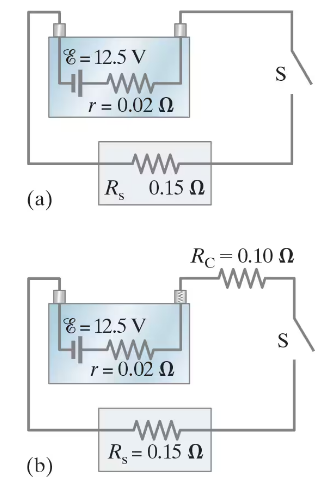
The performance of the starter circuit in a car can be significantly degraded by a small amount of corrosion on a battery terminal. Figure 26–88a depicts a properly functioning circuit with a battery (12.5-V emf, 0.02-Ω internal resistance) attached via corrosion-free cables to a starter motor of resistance Rs = 0.15Ω. Sometime later, corrosion between a battery terminal and a starter cable introduces an extra series resistance of only RC = 0.10Ω into the circuit as suggested in Fig. 26–88b. Let P0 be the power delivered to the starter in the circuit free of corrosion, and let P be the power delivered to the starter with corrosion. Determine the ratio P/P0.

Verified step by step guidance
1
Step 1: Start by understanding the circuit. In the first case (corrosion-free), the total resistance in the circuit is the sum of the internal resistance of the battery (Rᵢ = 0.02Ω) and the resistance of the starter motor (Rₛ = 0.15Ω). In the second case (with corrosion), an additional resistance R_C = 0.10Ω is introduced in series, so the total resistance becomes Rᵢ + Rₛ + R_C.
Step 2: Use Ohm's Law to calculate the current in each case. The current in the corrosion-free circuit is I₀ = ε / (Rᵢ + Rₛ), where ε is the emf of the battery (12.5 V). For the circuit with corrosion, the current is I = ε / (Rᵢ + Rₛ + R_C).
Step 3: Recall that the power delivered to the starter motor is given by P = I²Rₛ. For the corrosion-free circuit, the power is P₀ = I₀²Rₛ. For the circuit with corrosion, the power is P = I²Rₛ.
Step 4: Substitute the expressions for I₀ and I into the power formulas. For P₀, substitute I₀ = ε / (Rᵢ + Rₛ) into P₀ = I₀²Rₛ. For P, substitute I = ε / (Rᵢ + Rₛ + R_C) into P = I²Rₛ.
Step 5: Calculate the ratio P/P₀. This is given by (I²Rₛ) / (I₀²Rₛ). Simplify the ratio using the expressions for I and I₀, which results in P/P₀ = [(Rᵢ + Rₛ) / (Rᵢ + Rₛ + R_C)]². This is the final expression for the ratio of the power delivered to the starter motor with and without corrosion.

Verified video answer for a similar problem:

This video solution was recommended by our tutors as helpful for the problem above.
Video duration:
6m
Was this helpful?

Key Concepts

Here are the essential concepts you must grasp in order to answer the question correctly.

Ohm's Law

Ohm's Law states that the current (I) flowing through a conductor between two points is directly proportional to the voltage (V) across the two points and inversely proportional to the resistance (R) of the conductor. This relationship is expressed mathematically as V = IR. Understanding this law is crucial for analyzing how changes in resistance, such as those caused by corrosion, affect the current and power in an electrical circuit.
Recommended video:
Guided course
03:07
Resistance and Ohm's Law

Power in Electrical Circuits

The power (P) delivered in an electrical circuit can be calculated using the formula P = IV, where I is the current and V is the voltage. Additionally, power can also be expressed in terms of resistance as P = I²R or P = V²/R. This concept is essential for determining how the introduction of additional resistance from corrosion affects the overall power delivered to the starter motor.
Recommended video:
Guided course
06:18
Power in Circuits

Series Resistance

In a series circuit, the total resistance is the sum of the individual resistances. When corrosion introduces an additional resistance, it increases the total resistance in the circuit, which in turn reduces the current flowing through the circuit according to Ohm's Law. This concept is vital for understanding how the performance of the starter motor is impacted by the added resistance from corrosion.
Recommended video:
Guided course
12:42
Combining Resistors in Series & Parallel
Related Practice
Textbook Question

Measurements made on circuits that contain large resistances can be confusing. Consider a circuit powered by a battery ε = 15.000 V with a 10.00-MΩ resistor in series with an unknown resistor R. As shown in Fig. 26–92, a particular voltmeter reads V1 = 366 mV when connected across the 10.00 -MΩ resistor and this meter reads V2 = 7.317 V when connected across R. Determine the value of R. [Hint: Define RV as the voltmeter’s internal resistance.]


2
views
Textbook Question

Consider two unequal resistors, of resistance R1 and R2, that are connected either in series or in parallel. Fill in the Table below assuming the electric potential on the low-voltage end of the combination is VA volts and the potential at the high-voltage end of the combination is VB volts. First draw diagrams.


Textbook Question

A galvanometer has an internal resistance of 32 Ω and deflects full scale for a 48-μA current. Describe how to use this galvanometer to make a voltmeter to give a full scale deflection of 250 V.

1
views
Textbook Question

In the circuit shown in Fig. 26–75, the 33-Ω resistor dissipates 0.80 W. What is the battery voltage?

2
views
Textbook Question

A galvanometer has an internal resistance of 32 Ω and deflects full scale for a 48-μA current. Describe how to use this galvanometer to make an ammeter to read currents up to 25 A.

2
views
Textbook Question

The circuit shown in Fig. 26–89 is a primitive 4-bit digital-to-analog converter (DAC). In this circuit, to represent each digit (2n) of a binary number, a “1” has the nᵗʰ switch closed whereas zero (“0”) has the switch open. For example, 0010 is represented by closing switch n = 1, while all other switches are open. Show that the voltage V across the 1.0 - Ω resistor for the binary numbers 0001, 0010, 0100, and 1010 (which represent 1, 2, 4, 10) follows the pattern that you expect for a 4-bit DAC.


3
views