
(II) Two long parallel wires 8.20 cm apart carry 19.5-A dc currents in the same direction. Determine the magnetic field vector at a point P, 12.0 cm from one wire and 13.0 cm from the other. See Fig. 28–43. [Hint: Use the law of cosines. See Appendix A or inside rear cover.]
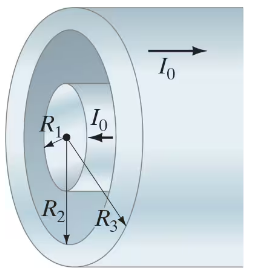
(III) A coaxial cable consists of a solid inner conductor of radius R1, surrounded by a concentric cylindrical tube of inner radius R2 and outer radius R3 (Fig. 28–45). The conductors carry equal and opposite currents I₀ distributed uniformly across their cross sections. Determine the magnetic field at a distance R from the axis for: (a) R < R1; (b) R1 < R < R2; (c) R2 < R < R3; (d) R > R3. (e) Let I₀ = 1.50 A, R1 = 1.00 cm , R2 = 2.00 cm , and R3 = 2.50 cm Graph B from R = 0 to R = 3.00 cm.

Verified step by step guidance
Verified video answer for a similar problem:
Key Concepts
Ampère's Law
Magnetic Field Inside a Conductor
Superposition Principle
(II) An electron enters a uniform magnetic field B = 0.28 T at a 45° angle to . Determine the radius r and pitch p (distance between loops) of the electron’s helical path assuming its speed is 2.2 x 10⁶ m/s. See Fig. 27–48.
(II) A circular conducting ring of radius 𝑅 is connected to two exterior straight wires at two ends of a diameter (Fig. 28–47). The current I splits into unequal portions as shown (unequal resistance) while passing through the ring. What is at the center of the ring?
(II) Two long wires are oriented so that they are perpendicular to each other. At their closest, they are 20.0 cm apart (Fig. 28–42). What is the magnitude of the magnetic field at a point midway between them if the top one carries a current of 18.0 A and the bottom one carries 12.0 A?
(II) Consider a straight section of wire of length d, as in Fig. 28–51, which carries a current I. (a) Show that the magnetic field at a point P a distance 𝑅 from the wire along its perpendicular bisector is
(b) Show that this is consistent with Example 28–10 for an infinite wire.
(II) A wire is formed into the shape of two half circles connected by equal-length straight sections as shown in Fig. 28–48. A current I flows in the circuit clockwise as shown. Determine (a) the magnitude and direction of the magnetic field at the center, C, and (b) the magnetic dipole moment of the circuit.
