
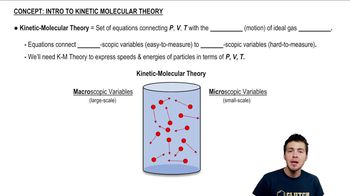
A space vehicle returning from the Moon enters the Earth’s atmosphere at a speed of about 42,000 km/h. Molecules (assume nitrogen) striking the nose of the vehicle with this speed correspond to what temperature? (Because of this high temperature, the nose of a space vehicle must be made of special materials; indeed, part of it does vaporize, and this is seen as a bright blaze upon reentry.)
A sample of cesium vapor is in an oven at 400°C. The volume of the oven is 75 cm³, the vapor pressure of Cs at 400°C is 17 mm-Hg, and the diameter of cesium atoms in the vapor is 0.33 nm. Determine the number of collisions a single Cs atom undergoes with other cesium atoms per second.
Verified step by step guidance
Verified video answer for a similar problem:
Key Concepts
Kinetic Molecular Theory
Collision Frequency
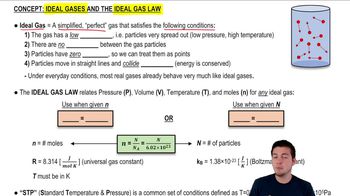
Ideal Gas Law
From the van der Waals equation of state, show that the critical temperature and pressure are given by Tcr = 8a / 27bR , Pcr = a / 27b². [Hint: Use the fact that the P versus V curve has an inflection point at the critical point so that the first and second derivatives are zero.]
At room temperature, it takes approximately 2.45 x 10³ J to evaporate 1.00 g of water. Estimate the average speed of evaporating molecules. What multiple of vrms (at 20°C) for water molecules is this? (Assume Eq. 18–4 holds.)
Using the ideal gas law, find an expression for the mean free path ℓM that involves pressure and temperature instead of (N/V). Use this expression to find the mean free path for nitrogen molecules at a pressure of 7.5 atm and 300 K.
Calculate the total water vapor pressure in the air on the following day: a hot summer day, with the temperature 30°C and the relative humidity at 75%.
