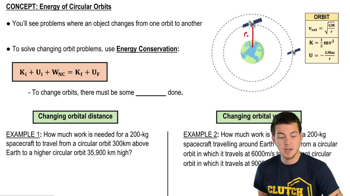
Ten days after it was launched toward Mars in December 1998, the Mars Climate Orbiter spacecraft (mass 629 kg) was 2.87 × 10⁶ km from the earth and traveling at 1.20 × 10⁴ km/h relative to the earth. At this time, what were (a) the spacecraft's kinetic energy relative to the earth and (b) the potential energy of the earth–spacecraft system?
On July 15, 2004, NASA launched the Aura spacecraft to study the earth's climate and atmosphere. This satellite was injected into an orbit 705 km above the earth's surface. Assume a circular orbit. How many hours does it take this satellite to make one orbit?
Verified step by step guidance
Verified video answer for a similar problem:
Key Concepts
Circular Orbit
Gravitational Force
Orbital Period
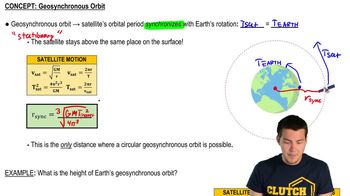
In its orbit each day, the International Space Station makes 15.65 revolutions around the earth. Assuming a circular orbit, how high is this satellite above the surface of the earth?
Two satellites are in circular orbits around a planet that has radius 9.00 × 10⁶ m. One satellite has mass 68.0 kg, orbital radius 7.00 × 10⁷ m, and orbital speed 4800 m/s. The second satellite has mass 84.0 kg and orbital radius 3.00 × 10⁷ m. What is the orbital speed of this second satellite?
For a satellite to be in a circular orbit 890 km above the surface of the earth, what orbital speed must it be given?
A planet orbiting a distant star has radius 3.24 × 10⁶ m. The escape speed for an object launched from this planet’s surface is 7.65 × 10³ m/s. What is the acceleration due to gravity at the surface of the planet?
The star Rho1 Cancri is 57 light-years from the earth and has a mass 0.85 times that of our sun. A planet has been detected in a circular orbit around Rho1 Cancri with an orbital radius equal to 0.11 times the radius of the earth's orbit around the sun. What are (a) the orbital speed and (b) the orbital period of the planet of Rho1 Cancri?
