
Textbook Question
A point source of light illuminates an aperture 2.0 m away. A 12.0-cm-wide bright patch of light appears on a screen 1.0 m behind the aperture. How wide is the aperture?
1
views

 Verified step by step guidance
 06:25
06:25
 01:04
01:04 02:01
02:01A point source of light illuminates an aperture 2.0 m away. A 12.0-cm-wide bright patch of light appears on a screen 1.0 m behind the aperture. How wide is the aperture?
A 5.0-cm-thick layer of oil is sandwiched between a 1.0-cm-thick sheet of glass and a 2.0-cm-thick sheet of polystyrene plastic. How long (in ns) does it take light incident perpendicular to the glass to pass through this 8.0-cm-thick sandwich?
It is 165 cm from your eyes to your toes. You're standing 200 cm in front of a tall mirror. How far is it from your eyes to the image of your toes?
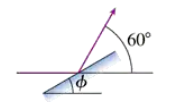
At what angle ϕ should the laser beam in FIGURE EX34.6 be aimed at the mirrored ceiling in order to hit the midpoint of the far wall?
A student has built a 15-cm-long pinhole camera for a science fair project. She wants to photograph her 180-cm-tall friend and have the image on the film be 5.0 cm high. How far should the front of the camera be from her friend?
When you look into your car's 5.0-cm-tall rear-view mirror from 35 cm away, the front of a bus, from the ground to the roof, exactly fills the mirror. If the bus is 17 m from the mirror, how tall is the bus?