


Ch 17: Temperature and Heat
Young & Freedman Calc - University Physics 14th Edition
Young & Freedman Calc14th EditionUniversity PhysicsISBN: 9780321973610Not the one you use?Change textbook
Chapter 17, Problem 22

A brass rod is 185 cm long and 1.60 cm in diameter. What force must be applied to each end of the rod to prevent it from contracting when it is cooled from 120.0°C to 10.0°C?

Verified step by step guidance
1
First, understand that the problem involves thermal contraction. When the temperature of the brass rod decreases, it tends to contract. To prevent this contraction, a force must be applied to counteract it.
Calculate the change in temperature (ΔT) using the formula: ΔT = T_final - T_initial, where T_final is 10.0°C and T_initial is 120.0°C.
Determine the change in length (ΔL) that would occur due to the temperature change if no force is applied. Use the formula: ΔL = α * L_initial * ΔT, where α is the coefficient of linear expansion for brass, L_initial is the initial length of the rod, and ΔT is the change in temperature.
To find the force required to prevent contraction, use Hooke's Law in the form: F = (A * Y * ΔL) / L_initial, where A is the cross-sectional area of the rod, Y is the Young's modulus for brass, and ΔL is the change in length calculated in the previous step.
Calculate the cross-sectional area (A) of the rod using the formula: A = π * (d/2)^2, where d is the diameter of the rod. Substitute this value into the force equation to find the force needed to prevent contraction.

Verified video answer for a similar problem:

This video solution was recommended by our tutors as helpful for the problem above.
Video duration:
5m
Was this helpful?

Key Concepts

Here are the essential concepts you must grasp in order to answer the question correctly.

Thermal Expansion

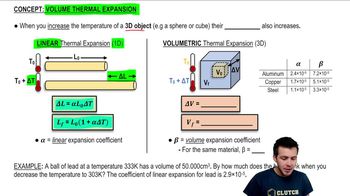
Thermal expansion refers to the tendency of matter to change in shape, area, and volume in response to a change in temperature. For solids like brass, the linear expansion can be calculated using the formula ΔL = αLΔT, where α is the coefficient of linear expansion, L is the original length, and ΔT is the change in temperature.
Recommended video:
Guided course
05:21
Volume Thermal Expansion

Young's Modulus

Young's modulus is a measure of the stiffness of a solid material. It is defined as the ratio of tensile stress to tensile strain. In the context of preventing contraction, Young's modulus helps determine the force needed to counteract the change in length due to temperature variation, using the formula F = (Y * A * ΔL) / L, where Y is Young's modulus, A is the cross-sectional area, and ΔL is the change in length.
Recommended video:
Guided course
12:00
Young's Double Slit Experiment

Stress and Strain

Stress is the force applied per unit area within materials, while strain is the deformation or displacement of material that results from an applied stress. Understanding these concepts is crucial for calculating the force needed to prevent contraction, as the applied force must counteract the stress induced by thermal contraction, ensuring the rod maintains its original dimensions.
Recommended video:
07:49
Ray Diagrams for Convex Mirrors
Related Practice
Textbook Question

In very cold weather a significant mechanism for heat loss by the human body is energy expended in warming the air taken into the lungs with each breath. On a cold winter day when the temperature is -20°C, what amount of heat is needed to warm to body temperature (37°C) the 0.50 L of air exchanged with each breath? Assume that the specific heat of air is 1020 J/kg K and that 1.0 L of air has mass 1.3 × 10⁻³ kg.

1
views
Textbook Question

A steel tank is completely filled with 1.90 m3 of ethanol when both the tank and the ethanol are at 32.0°C. When the tank and its contents have cooled to 18.0°C, what additional volume of ethanol can be put into the tank?

1
views
Textbook Question

Steel train rails are laid in 12.0-m-long segments placed end to end. The rails are laid on a winter day when their temperature is -9.0°C. How much space must be left between adjacent rails if they are just to touch on a summer day when their temperature is 33.0°C?

2
views
Textbook Question

As a new mechanical engineer for Engines Inc., you have been assigned to design brass pistons to slide inside steel cylinders. The engines in which these pistons will be used will operate between 20.0°C and 150.0°C. Assume that the coefficients of expansion are constant over this temperature range. If the piston just fits inside the chamber at 20.0°C, will the engines be able to run at higher temperatures? Explain.

1
views
Textbook Question

While painting the top of an antenna 225 m in height, a worker accidentally lets a 1.00-L water bottle fall from his lunchbox. The bottle lands in some bushes at ground level and does not break. If a quantity of heat equal to the magnitude of the change in mechanical energy of the water goes into the water, what is its increase in temperature?

Textbook Question

In an effort to stay awake for an all-night study session, a student makes a cup of coffee by first placing a 200-W electric immersion heater in 0.320 kg of water. How much time is required? Assume that all of the heater's power goes into heating the water.

1
views