
Ch. 06 - Gravitation and Newton's Synthesis
Giancoli Douglas - Physics for Scientists and Engineers 5th edition
Giancoli Douglas5th editionPhysics for Scientists and EngineersISBN: 9780137488179Not the one you use?Change textbook
Chapter 6, Problem 50

Determine the mean distance from Jupiter for each of Jupiter’s principal moons, using Kepler’s third law. Use the mean distance of Io and the periods given in Table 6–3. Compare your results to the values in Table 6–3.

Verified step by step guidance
1
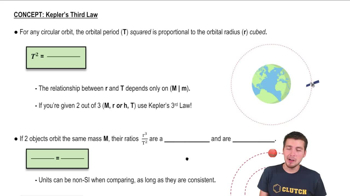
Identify the relevant data from the problem: the orbital period (T) and mean distance (r) of Io, which will serve as a reference. Kepler's third law states that \( T^2 \propto r^3 \), or mathematically \( \frac{T_1^2}{r_1^3} = \frac{T_2^2}{r_2^3} \). This relationship will allow us to calculate the mean distances for the other moons.
Write down Kepler's third law in its proportional form: \( \frac{T_1^2}{r_1^3} = \frac{T_2^2}{r_2^3} \). Here, \( T_1 \) and \( r_1 \) are the period and mean distance of Io, and \( T_2 \) and \( r_2 \) are the period and mean distance of another moon.
Rearrange the equation to solve for \( r_2 \): \( r_2 = \left( \frac{T_2^2}{T_1^2} \cdot r_1^3 \right)^{1/3} \). This formula will allow you to calculate the mean distance \( r_2 \) for each of Jupiter's other moons using their orbital periods \( T_2 \).
Substitute the known values for Io (\( T_1 \) and \( r_1 \)) and the orbital period \( T_2 \) of each moon into the formula. Perform the calculations for each moon to determine its mean distance \( r_2 \).
Compare the calculated mean distances \( r_2 \) for each moon to the values provided in Table 6–3. Note any discrepancies and consider possible sources of error, such as rounding or assumptions in the data.

Verified video answer for a similar problem:

This video solution was recommended by our tutors as helpful for the problem above.
Video duration:
7m
Was this helpful?

Key Concepts

Here are the essential concepts you must grasp in order to answer the question correctly.

Kepler's Third Law

Kepler's Third Law states that the square of the orbital period of a planet is directly proportional to the cube of the semi-major axis of its orbit. This law can be expressed mathematically as T² ∝ r³, where T is the orbital period and r is the mean distance from the sun. This relationship allows us to calculate the distances of moons from their planet based on their orbital periods.
Recommended video:
Guided course
08:32
Kepler's Third Law

Orbital Period

The orbital period is the time it takes for a celestial body to complete one full orbit around another body. For moons, this is the time taken to orbit their planet. Understanding the orbital period is crucial for applying Kepler's Third Law, as it directly influences the calculation of the mean distance from the planet.
Recommended video:
Guided course
04:45
Geosynchronous Orbits

Mean Distance

Mean distance refers to the average distance between a moon and its planet during its orbit. This distance can vary due to the elliptical shape of orbits, but for calculations using Kepler's Third Law, it is often simplified to the semi-major axis of the orbit. Accurate mean distance values are essential for comparing calculated results with known data.
Recommended video:
Guided course
08:20
Mean Free Path
Related Practice
Textbook Question

A particle is released at a height rE (radius of Earth) above the Earth’s surface. Determine its velocity when it hits the Earth. Ignore air resistance. [Hint: Use Newton’s second law, the law of universal gravitation, the chain rule, and integrate.]

1
views
Textbook Question

An inclined plane, fixed to the inside of an elevator, makes a 38° angle with the floor. A mass m slides on the plane without friction. What is its acceleration relative to the plane if the elevator moves upward at constant speed?

1
views
Textbook Question

A plumb bob (a mass m hanging on a string) is deflected from the vertical by an angle θ due to a massive mountain nearby (Fig. 6–37). Estimate the angle θ of the plumb bob if it is 5 km from the center of Mt. Everest.

1
views
Textbook Question

A satellite circles a spherical planet of unknown mass in a circular orbit of radius 1.6 x 10⁷ m. The magnitude of the gravitational force exerted on the satellite by the planet is 120 N. What would be the magnitude of the gravitational force exerted on the satellite by the planet if the radius of the orbit were increased to 3.0 x 10⁷m?

1
views
Textbook Question

An inclined plane, fixed to the inside of an elevator, makes a 38° angle with the floor. A mass m slides on the plane without friction. What is its acceleration relative to the plane if the elevator accelerates downward at 0.50 g?

1
views
Textbook Question

An inclined plane, fixed to the inside of an elevator, makes a 38° angle with the floor. A mass m slides on the plane without friction. What is its acceleration relative to the plane if the elevator falls freely?

1
views