At the instant when the current in an inductor is increasing at a rate of 0.0640 A/s, the magnitude of the self-induced emf is 0.0160 V. What is the inductance of the inductor?
Ch 30: Inductance
Young & Freedman Calc14th EditionUniversity PhysicsISBN: 9780321973610Not the one you use?Change textbook
Chapter 30, Problem 7a
A 2.50-mH toroidal solenoid has an average radius of 6.00 cm and a cross-sectional area of 2.00 cm2. How many coils does it have? (Make the same assumption as in Example 30.3.)
Verified step by step guidance1
Start by recalling the formula for the inductance of a toroidal solenoid: \( L = \frac{\mu_0 N^2 A}{2\pi r} \), where \( L \) is the inductance, \( \mu_0 \) is the permeability of free space, \( N \) is the number of turns, \( A \) is the cross-sectional area, and \( r \) is the average radius.
Rearrange the formula to solve for the number of turns \( N \): \( N = \sqrt{\frac{2\pi r L}{\mu_0 A}} \).
Substitute the given values into the equation: \( L = 2.50 \times 10^{-3} \text{ H} \), \( r = 6.00 \times 10^{-2} \text{ m} \), and \( A = 2.00 \times 10^{-4} \text{ m}^2 \).
Use the value of the permeability of free space \( \mu_0 = 4\pi \times 10^{-7} \text{ T}\cdot\text{m/A} \) in the equation.
Calculate \( N \) using the rearranged formula and the substituted values to find the number of coils in the toroidal solenoid.

Verified video answer for a similar problem:
This video solution was recommended by our tutors as helpful for the problem above.
Video duration:
4mWas this helpful?
Key Concepts
Here are the essential concepts you must grasp in order to answer the question correctly.
Inductance of a Solenoid
Inductance is a measure of the ability of a solenoid to store energy in its magnetic field. For a toroidal solenoid, the inductance (L) is determined by the number of turns (N), the cross-sectional area (A), and the average radius (r) of the solenoid. The formula L = (μ₀N²A)/(2πr) relates these parameters, where μ₀ is the permeability of free space.
Recommended video:
Guided course
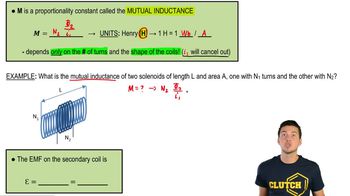
Mutual Induction
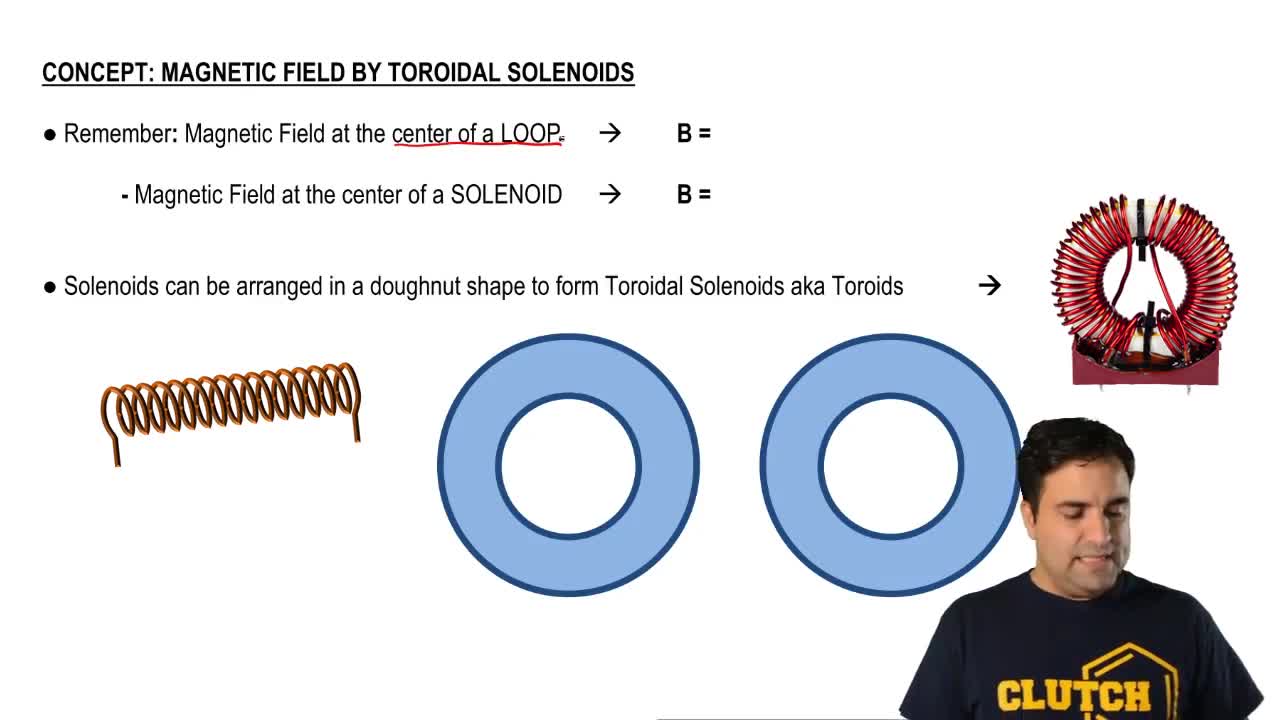
Toroidal Solenoid
A toroidal solenoid is a coil shaped like a doughnut, with wire wound around a circular path. Unlike a straight solenoid, a toroidal solenoid confines the magnetic field within its core, minimizing external magnetic fields. This design is crucial for applications requiring minimal interference with surrounding components.
Recommended video:
Guided course
Toroidal Solenoids aka Toroids
Permeability of Free Space
The permeability of free space (μ₀) is a fundamental physical constant that describes how a magnetic field interacts with a vacuum. It is essential in calculating the inductance of solenoids and other electromagnetic devices. Its value is approximately 4π × 10⁻⁷ T·m/A, and it helps determine the strength of the magnetic field generated by a current-carrying coil.
Recommended video:
Guided course
Spinning Space Station
Related Practice
Textbook Question
2
views
Textbook Question
At the instant when the current in an inductor is increasing at a rate of 0.0640 A/s, the magnitude of the self-induced emf is 0.0160 V. If the inductor is a solenoid with 400 turns, what is the average magnetic flux through each turn when the current is 0.720 A?
2
views
Textbook Question
Two coils have mutual inductance M = 3.25 × 10⁻⁴ H. The current i1 in the first coil increases at a uniform rate of 830 A/s. What is the magnitude of the induced emf in the second coil? Is it constant?
Textbook Question
When the current in a toroidal solenoid is changing at a rate of 0.0260 A/s, the magnitude of the induced emf is 12.6 mV. When the current equals 1.40 A, the average flux through each turn of the solenoid is 0.00285 Wb. How many turns does the solenoid have?
2
views