
Ch 13: Gravitation
Young & Freedman Calc - University Physics 14th Edition
Young & Freedman Calc14th EditionUniversity PhysicsISBN: 9780321973610Not the one you use?Change textbook
Chapter 13, Problem 21a

For a satellite to be in a circular orbit 890 km above the surface of the earth, what orbital speed must it be given?

Verified step by step guidance
1
First, determine the radius of the satellite's orbit. The radius is the sum of the Earth's radius and the altitude of the satellite. The Earth's average radius is approximately 6371 km. Therefore, the orbital radius \( r \) is \( 6371 \, \text{km} + 890 \, \text{km} \). Convert this total distance into meters for consistency in units.
Next, use the formula for the gravitational force acting as the centripetal force required for circular motion: \( F = \frac{G M m}{r^2} = \frac{m v^2}{r} \), where \( G \) is the gravitational constant \( 6.674 \times 10^{-11} \, \text{N} \, \text{m}^2/\text{kg}^2 \), \( M \) is the mass of the Earth \( 5.972 \times 10^{24} \, \text{kg} \), \( m \) is the mass of the satellite, \( v \) is the orbital speed, and \( r \) is the orbital radius.
Cancel the mass of the satellite \( m \) from both sides of the equation, as it appears in both the gravitational force and the centripetal force expressions. This simplifies the equation to \( \frac{G M}{r^2} = \frac{v^2}{r} \).
Rearrange the equation to solve for the orbital speed \( v \): \( v = \sqrt{\frac{G M}{r}} \).
Substitute the known values for \( G \), \( M \), and \( r \) into the equation to calculate the orbital speed \( v \). Ensure all units are consistent, particularly that \( r \) is in meters, to find the speed in meters per second.

Verified video answer for a similar problem:

This video solution was recommended by our tutors as helpful for the problem above.
Video duration:
2m
Was this helpful?

Key Concepts

Here are the essential concepts you must grasp in order to answer the question correctly.

Circular Orbit

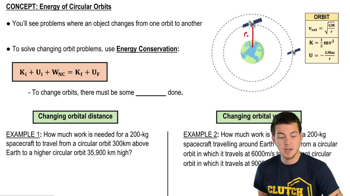
A circular orbit is a path where a satellite moves around a celestial body in a circle. The gravitational force provides the necessary centripetal force to keep the satellite in orbit. Understanding circular orbits is crucial for calculating the orbital speed required to maintain a stable path around Earth.
Recommended video:
Guided course
9:11
Energy of Circular Orbits

Gravitational Force

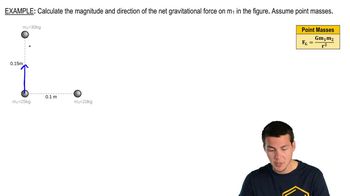
Gravitational force is the attractive force between two masses, such as Earth and a satellite. It is given by Newton's law of universal gravitation, which states that the force is proportional to the product of the masses and inversely proportional to the square of the distance between them. This force is essential for determining the conditions for a satellite's orbit.
Recommended video:
Guided course
05:41
Gravitational Forces in 2D

Orbital Speed

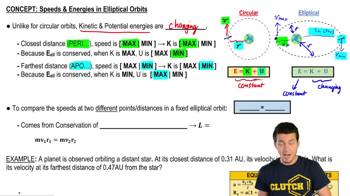
Orbital speed is the velocity a satellite must have to maintain its orbit around a planet. It depends on the mass of the planet and the radius of the orbit. For a satellite 890 km above Earth's surface, calculating the orbital speed involves using the formula derived from equating gravitational force to centripetal force, ensuring the satellite remains in a stable circular orbit.
Recommended video:
Guided course
6:03
Speed and Energy of Elliptical Orbits
Related Practice
Textbook Question

Ten days after it was launched toward Mars in December 1998, the Mars Climate Orbiter spacecraft (mass 629 kg) was 2.87 × 10⁶ km from the earth and traveling at 1.20 × 10⁴ km/h relative to the earth. At this time, what were (a) the spacecraft's kinetic energy relative to the earth and (b) the potential energy of the earth–spacecraft system?

Textbook Question

Use the results of Example 13.5 (Section 13.3) to calculate the escape speed for a spacecraft (a) from the surface of Mars and (b) from the surface of Jupiter. Use the data in Appendix F. (c) Why is the escape speed for a spacecraft independent of the spacecraft's mass?

Textbook Question

In its orbit each day, the International Space Station makes 15.65 revolutions around the earth. Assuming a circular orbit, how high is this satellite above the surface of the earth?

1
views
Textbook Question

Two satellites are in circular orbits around a planet that has radius 9.00 × 10⁶ m. One satellite has mass 68.0 kg, orbital radius 7.00 × 10⁷ m, and orbital speed 4800 m/s. The second satellite has mass 84.0 kg and orbital radius 3.00 × 10⁷ m. What is the orbital speed of this second satellite?

1
views
Textbook Question

On July 15, 2004, NASA launched the Aura spacecraft to study the earth's climate and atmosphere. This satellite was injected into an orbit 705 km above the earth's surface. Assume a circular orbit. How many hours does it take this satellite to make one orbit?

2
views
Textbook Question

A planet orbiting a distant star has radius 3.24 × 10⁶ m. The escape speed for an object launched from this planet’s surface is 7.65 × 10³ m/s. What is the acceleration due to gravity at the surface of the planet?

1
views