Ch. 06 - Gravitation and Newton's Synthesis
Giancoli Douglas - Physics for Scientists and Engineers 5th edition
Giancoli Douglas5th editionPhysics for Scientists and EngineersISBN: 9780137488179Not the one you use?Change textbook
Chapter 6, Problem 10

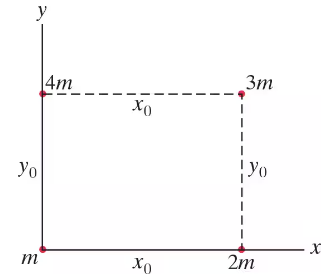
Four masses are arranged as shown in Fig. 6–28. Determine the x and y components of the gravitational force on the mass at the origin (m). Write the force in vector notation (î, ĵ).
Diagram showing four masses arranged in a 2D coordinate system, with labels for their positions and gravitational force components.

Verified step by step guidance
1
Identify the masses and their positions relative to the origin. Assign coordinates to each mass (e.g., m1, m2, m3, m4) based on the figure. Assume the origin is at (0, 0) and the masses are located at specific coordinates (x, y).
Use Newton's law of gravitation to calculate the gravitational force between the mass at the origin (m) and each of the other masses. The formula is: F=Gmmir2, where G is the gravitational constant, m is the mass at the origin, mi is the mass of the other object, and r is the distance between the two masses.
Break each gravitational force into its x and y components. For a mass located at (xi, yi), the x-component of the force is: Fx=Fixr, and the y-component is: Fy=Fiyr, where r is the distance between the origin and the mass.
Sum the x-components and y-components of the forces from all the masses to find the net gravitational force in the x and y directions. Use: Fx=Fx and Fy=Fy.
Express the net gravitational force in vector notation as: F=Fxi+Fyj. This is the final representation of the gravitational force on the mass at the origin.

Verified video answer for a similar problem:

This video solution was recommended by our tutors as helpful for the problem above.
Video duration:
12m
Was this helpful?

Key Concepts

Here are the essential concepts you must grasp in order to answer the question correctly.

Gravitational Force

Gravitational force is the attractive force between two masses, described by Newton's law of universal gravitation. It states that the force is directly proportional to the product of the masses and inversely proportional to the square of the distance between their centers. This force acts along the line connecting the centers of the two masses and is crucial for understanding how objects interact under gravity.
Recommended video:
Guided course
05:41
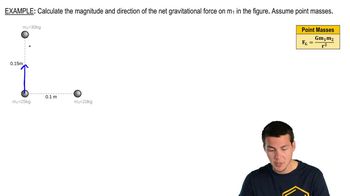
Gravitational Forces in 2D

Vector Components

Vectors are quantities that have both magnitude and direction. In physics, forces are often represented as vectors, which can be broken down into components along the x and y axes. This decomposition allows for easier calculations and analysis of forces acting in different directions, particularly when multiple forces are involved, as in the case of the masses in the problem.
Recommended video:
Guided course
07:30
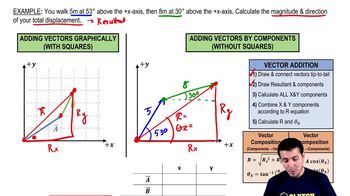
Vector Addition By Components

Equilibrium and Net Force

An object is in equilibrium when the net force acting on it is zero, meaning all the forces balance out. In the context of the problem, calculating the gravitational forces acting on the mass at the origin involves summing the forces from the other masses and determining their resultant vector. Understanding equilibrium helps in analyzing whether the mass will remain stationary or move due to the net force.
Recommended video: