Ch. 18 - Kinetic Theory of Gases
Giancoli Douglas - Physics for Scientists and Engineers 5th edition
Giancoli Douglas5th editionPhysics for Scientists and EngineersISBN: 9780137488179Not the one you use?Change textbook
Chapter 18, Problem 25b

For what range of pressures and temperatures can CO₂ be a liquid? Refer to Fig. 18-6.

Verified step by step guidance
1
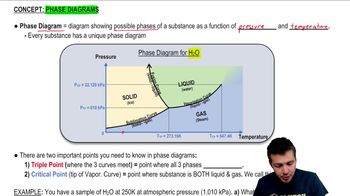
Refer to the phase diagram of CO₂ (Fig. 18.9.6) to identify the regions where CO₂ exists as a liquid. A phase diagram shows the states of matter (solid, liquid, gas) as a function of pressure and temperature.
Locate the triple point on the diagram. The triple point is the specific pressure and temperature where solid, liquid, and gas phases coexist. For CO₂, the triple point occurs at approximately 5.11 atm and 216.6 K.
Identify the critical point on the diagram. The critical point is the highest temperature and pressure at which CO₂ can exist as a liquid. Beyond this point, CO₂ becomes a supercritical fluid. For CO₂, the critical point is approximately 73 atm and 304.2 K.
Determine the range of pressures and temperatures where the liquid phase exists. This is the region between the triple point and the critical point, bounded by the liquid-gas equilibrium curve. The pressure must be greater than 5.11 atm and less than 73 atm, and the temperature must be between 216.6 K and 304.2 K.
Conclude that CO₂ can exist as a liquid only within the specified range of pressures and temperatures. Outside this range, it will either be a solid, gas, or supercritical fluid depending on the conditions.

Verified video answer for a similar problem:

This video solution was recommended by our tutors as helpful for the problem above.
Video duration:
2m
Was this helpful?

Key Concepts

Here are the essential concepts you must grasp in order to answer the question correctly.

Phase Diagram of CO₂

A phase diagram illustrates the states of a substance (solid, liquid, gas) under varying temperature and pressure conditions. For CO₂, the diagram shows the regions where it exists as a liquid, solid, or gas, and highlights critical points such as the triple point and critical point, which are essential for understanding the conditions under which CO₂ can be a liquid.
Recommended video:
Guided course
06:59
Phase Diagrams

Critical Point

The critical point of a substance is the temperature and pressure at which the distinction between liquid and gas phases disappears. For CO₂, this point indicates the maximum temperature and pressure at which it can exist as a liquid. Above this point, CO₂ cannot be liquefied regardless of the pressure applied.
Recommended video:
Guided course
06:59
Phase Diagrams

Triple Point

The triple point of a substance is the unique set of conditions at which all three phases (solid, liquid, and gas) coexist in equilibrium. For CO₂, the triple point occurs at a specific temperature and pressure, providing a reference for the conditions under which CO₂ can transition between its phases, including the liquid state.
Recommended video:
Guided course
06:59
Phase Diagrams
Related Practice
Textbook Question

Water is in which phase when the pressure is 0.01 atm and the temperature is 90°C?

1
views

Textbook Question

Below a certain threshold pressure, the air molecules (0.3-nm diameter) within a research vacuum chamber are in the “collision-free regime,” meaning that a particular air molecule is as likely to cross the container and collide with the opposite wall as it is to collide with another air molecule. Estimate the threshold pressure for a vacuum chamber of side 1.0 m at 20°C.

1
views
Textbook Question

Estimate how many air molecules rebound from a wall in a typical room per second, assuming an ideal gas of N molecules contained in a cubic room with sides of length ℓ at temperature T and pressure P.

(a) Show that the frequency f with which gas molecules strike a wall is ƒ = (υx\(\overline{\upsilon_{x}\)} /2)(P/kT) ℓ² where υx\(\overline{\upsilon_{x}\)} is the average x component of the molecule’s velocity.

(b) Show that the equation can then be written as ƒ≈ Pℓ² /4mkT\(\sqrt{4mkT}\) where m is the mass of a gas molecule.

1
views
Textbook Question

A gas consisting of 14,500 molecules, each of mass 2.00 x 10⁻²⁶ kg, has the following distribution of speeds, which crudely mimics the Maxwell distribution. Determine vᵣₘₛ for this distribution of speeds.

1
views
Textbook Question

At about what pressure would the mean free path of air molecules be 0.30 m? Assume T = 20° C.

1
views
Textbook Question

A 1.0-mol sample of helium gas has a temperature of 18°C. What is the total kinetic energy of all the gas atoms in the sample?