
Ch. 24 - Capacitance, Dielectrics, Electric Energy, Storage
Giancoli Douglas - Physics for Scientists and Engineers 5th edition
Giancoli Douglas5th editionPhysics for Scientists and EngineersISBN: 9780137488179Not the one you use?Change textbook
Chapter 23, Problem 85b

A parallel-plate capacitor with plate area 2.0 cm² and air-gap separation 0.50 mm is connected to a 12-V battery, and fully charged. The battery is then disconnected. The plates are now pulled to a separation of 0.85 mm. What is the charge on the capacitor now?

Verified step by step guidance
1
Understand the problem: A parallel-plate capacitor is initially charged by a 12-V battery, then disconnected. The plate separation is increased, and we need to determine the charge on the capacitor after the separation change.
Recall that the charge on a capacitor is given by the formula: Q = CV, where Q is the charge, C is the capacitance, and V is the voltage. Since the battery is disconnected, the charge Q remains constant regardless of the plate separation.
The capacitance of a parallel-plate capacitor is given by: C = εd, where ε is the permittivity of free space (8.85 × 10⁻¹² F/m), A is the plate area, and d is the plate separation.
Substitute the given values into the capacitance formula to calculate the initial capacitance: C = εd, where A = 2.0 × 10⁻⁴ m² and d = 0.50 × 10⁻³ m.
Since the charge remains constant after the battery is disconnected, the charge on the capacitor is the same as it was initially. Use the formula Q = CV with the initial capacitance and voltage to find the charge. The separation change does not affect the charge because the battery is disconnected.

Verified video answer for a similar problem:

This video solution was recommended by our tutors as helpful for the problem above.
Video duration:
4m
Was this helpful?

Key Concepts

Here are the essential concepts you must grasp in order to answer the question correctly.

Capacitance

Capacitance is a measure of a capacitor's ability to store charge per unit voltage. It is defined as C = Q/V, where C is capacitance, Q is the charge stored, and V is the voltage across the plates. For a parallel-plate capacitor, capacitance can also be expressed as C = ε₀(A/d), where ε₀ is the permittivity of free space, A is the plate area, and d is the separation between the plates.
Recommended video:
Guided course
08:02
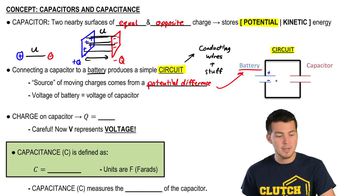
Capacitors & Capacitance (Intro)

Charge Conservation

Charge conservation is a fundamental principle stating that the total electric charge in an isolated system remains constant. When the battery is disconnected from the capacitor, the charge stored on the plates remains fixed, even if the separation between the plates changes. This means that the initial charge before the plates are pulled apart will equal the charge after the separation is increased.
Recommended video:
Guided course
05:43
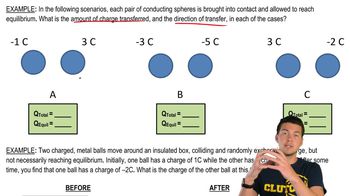
Conservation of Charge

Effect of Plate Separation on Capacitance

The capacitance of a parallel-plate capacitor is inversely proportional to the distance between the plates. As the separation increases, the capacitance decreases, which affects the voltage across the capacitor if the charge remains constant. When the plates are pulled apart, the voltage increases, and the relationship between charge, capacitance, and voltage must be considered to determine the new charge on the capacitor.
Recommended video:
Guided course
08:53
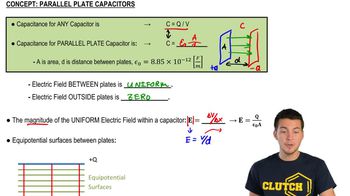
Parallel Plate Capacitors
Related Practice
Textbook Question

In lightning storms, the potential difference between the Earth and the bottom of the thunderclouds can be as high as 35,000,000 V. The bottoms of thunderclouds are typically 1500 m above the Earth, and can have an area of 110 km². Modeling the Earth–cloud system as a huge capacitor, calculate the capacitance of the Earth–cloud system,

2
views
Textbook Question

A parallel-plate capacitor with plate area 2.0 cm² and air-gap separation 0.50 mm is connected to a 12-V battery, and fully charged. The battery is then disconnected. What is the charge on the capacitor?

2
views
Textbook Question

Capacitors can be used as “electric charge counters.” Consider an initially uncharged capacitor of capacitance C with its bottom plate grounded and its top plate connected to a source of electrons. If N electrons flow onto the capacitor’s top plate, show that the resulting potential difference V across the capacitor is directly proportional to N.

2
views
Textbook Question

The capacitor shown in Fig. 24–34 is connected to an 80.0-V battery. Calculate (and sketch) the electric field everywhere between the capacitor plates. Find both the free charge on each capacitor plate and the induced charge on the faces of the glass dielectric plate.

1
views
Textbook Question

A parallel-plate capacitor has square plates 12 cm on a side separated by 0.10 mm of plastic with a dielectric constant of K = 3.8. The plates are connected to a battery, causing them to become oppositely charged. Since the oppositely charged plates attract each other, they exert a pressure on the dielectric. If this pressure is 40.0 Pa, what is the battery voltage?

4
views