Textbook Question
Vector A has y-component Ay = +9.60 m. A makes an angle of 32.0° counterclockwise from the +y-axis. (a) What is the x-component of A? (b) What is the magnitude of A?
1
views
 Young & Freedman Calc 14th EditionCh 01: Units, Physical Quantities & VectorsProblem 31a
 Verified step by step guidance
 07:30
07:30 07:30
07:30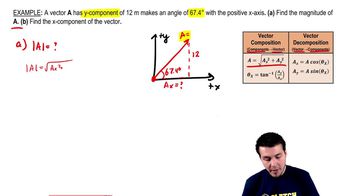 03:59
03:59Vector A has y-component Ay = +9.60 m. A makes an angle of 32.0° counterclockwise from the +y-axis. (a) What is the x-component of A? (b) What is the magnitude of A?
Compute the x- and y-components of the vectors A, B, C, and D in Fig. E1.24.
Let θ be the angle that the vector A makes with the +x-axis, measured counterclockwise from that axis. Find angle θ for a vector that has these components: Ax = 2.00m, Ay = −1.00 m
A postal employee drives a delivery truck over the route shown in Fig. E1.25. Use the method of components to determine the magnitude and direction of her resultant displacement. In a vector-addition diagram (roughly to scale), show that the resultant displacement found from your diagram is in qualitative agreement with the result you obtained by using the method of components.
For the vectors A and B in Fig. E1.24 use the method of components to find the magnitude and direction of the vector difference B - A
For the vectors A and B in Fig. E1.24 use the method of components to find the magnitude and direction of the vector difference A - B