
Textbook Question
Two 10-cm-diameter charged rings face each other, 20 cm apart. The left ring is charged to −20 nC and the right ring is charged to +20 nC. What is the force on a proton at the midpoint?
1
views

 Verified step by step guidance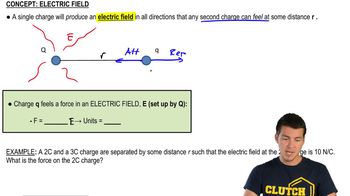
 03:16
03:16
 03:32
03:32 07:12
07:12Two 10-cm-diameter charged rings face each other, 20 cm apart. The left ring is charged to −20 nC and the right ring is charged to +20 nC. What is the force on a proton at the midpoint?
Two 10-cm-diameter charged disks face each other, 20 cm apart. The left disk is charged to −50 nC and the right disk is charged to +50 nC. a. What is the electric field Ē, both magnitude and direction, at the midpoint between the two disks?
CALC A 12-cm-long thin rod has the nonuniform charge density , where x is measured from the center of the rod. What is the total charge on the rod? Hint: This exercise requires an integration. Think about how to handle the absolute value sign.
You’ve hung two very large sheets of plastic facing each other with distance d between them, as shown in FIGURE EX23.19. By rubbing them with wool and silk, you’ve managed to give one sheet a uniform surface charge density and the other a uniform surface charge density . What are the electric field vectors at points 1, 2, and 3?
A small glass bead charged to +6.0 nC is in the plane that bisects a thin, uniformly charged, 10-cm-long glass rod and is 4.0 cm from the rod's center. The bead is repelled from the rod with a force of 840 μN. What is the total charge on the rod?
Two 10-cm-long thin glass rods uniformly charged to +10 nC are placed side by side, 4.0 cm apart. What are the electric field strengths E1 to E3 at distances 1.0 cm, 2.0 cm, and 3.0 cm to the right of the rod on the left along the line connecting the midpoints of the two rods?