Ch 17: Temperature and Heat
Young & Freedman Calc - University Physics 14th Edition
Young & Freedman Calc14th EditionUniversity PhysicsISBN: 9780321973610Not the one you use?Change textbook
Chapter 17, Problem 39

A copper pot with a mass of 0.500 kg contains 0.170 kg of water, and both are at 20.0°C. A 0.250-kg block of iron at 85.0°C is dropped into the pot. Find the final temperature of the system, assuming no heat loss to the surroundings.

Verified step by step guidance
1
Identify the specific heat capacities of the materials involved: copper, water, and iron. These values are typically found in physics textbooks or reliable online sources.
Set up the heat transfer equation based on the principle of conservation of energy, which states that the heat lost by the iron will be equal to the heat gained by the copper pot and the water. Use the formula: \( Q = mc\Delta T \), where \( Q \) is the heat transferred, \( m \) is the mass, \( c \) is the specific heat capacity, and \( \Delta T \) is the change in temperature.
Express the heat lost by the iron as \( Q_{iron} = m_{iron}c_{iron}(T_{initial, iron} - T_{final}) \), where \( T_{initial, iron} \) is the initial temperature of the iron block and \( T_{final} \) is the final equilibrium temperature of the system.
Express the heat gained by the copper pot and water as \( Q_{copper} = m_{copper}c_{copper}(T_{final} - T_{initial, copper}) \) and \( Q_{water} = m_{water}c_{water}(T_{final} - T_{initial, water}) \), where \( T_{initial, copper} \) and \( T_{initial, water} \) are the initial temperatures of the copper pot and water, respectively.
Set the sum of the heat gained by the copper pot and water equal to the heat lost by the iron: \( Q_{iron} = Q_{copper} + Q_{water} \). Solve this equation for \( T_{final} \) to find the final temperature of the system.

Verified video answer for a similar problem:

This video solution was recommended by our tutors as helpful for the problem above.
Video duration:
8m
Was this helpful?

Key Concepts

Here are the essential concepts you must grasp in order to answer the question correctly.

Specific Heat Capacity

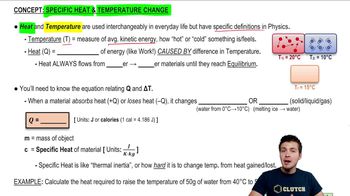
Specific heat capacity is the amount of heat required to change the temperature of a unit mass of a substance by one degree Celsius. It is crucial in this problem as it determines how much heat each material (copper, water, and iron) will absorb or release as they reach thermal equilibrium. Different materials have different specific heat capacities, affecting the final temperature calculation.
Recommended video:
Guided course
06:50
Specific Heat & Temperature Changes

Conservation of Energy

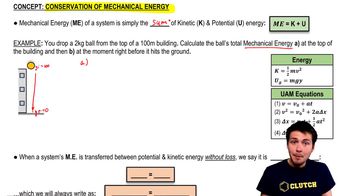
The principle of conservation of energy states that energy cannot be created or destroyed, only transferred or converted from one form to another. In this context, it implies that the total heat lost by the iron block must equal the total heat gained by the copper pot and the water, assuming no heat is lost to the surroundings. This principle is essential for setting up the equation to find the final temperature.
Recommended video:
Guided course
06:24
Conservation Of Mechanical Energy

Thermal Equilibrium

Thermal equilibrium occurs when two or more objects in thermal contact reach the same temperature and no net heat flows between them. In this problem, the final temperature of the system is the point at which the copper pot, water, and iron block have exchanged heat and reached a uniform temperature. Understanding this concept helps in setting up the equations needed to solve for the final temperature.
Recommended video:
Guided course
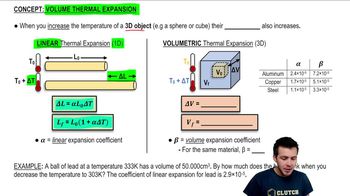
05:21
Volume Thermal Expansion
Related Practice
Textbook Question

A copper calorimeter can with mass 0.100 kg contains 0.160 kg of water and 0.0180 kg of ice in thermal equilibrium at atmospheric pressure. If 0.750 kg of lead at 255°C is dropped into the calorimeter can, what is the final temperature? Assume that no heat is lost to the surroundings.

1
views
Textbook Question

One suggested treatment for a person who has suffered a stroke is immersion in an ice-water bath at 0°C to lower the body temperature, which prevents damage to the brain. In one set of tests, patients were cooled until their internal temperature reached 32.0°C. To treat a 70.0 kg patient, what is the minimum amount of ice (at 0°C) you need in the bath so that its temperature remains at 0°C? The specific heat of the human body is 3480 J/kg C°, and recall that normal body temperature is 37.0°C.

1
views
Textbook Question

An asteroid with a diameter of 10 km and a mass of 2.60 × 10¹⁵ kg impacts the earth at a speed of 32.0 km/s, landing in the Pacific Ocean. If 1.00% of the asteroid's kinetic energy goes to boiling the ocean water (assume an initial water temperature of 10.0°C), what mass of water will be boiled away by the collision? (For comparison, the mass of water contained in Lake Superior is about 2 × 10¹⁵ kg.)

2
views
Textbook Question

A blacksmith cools a 1.20 kg chunk of iron, initially at 650.0°C, by trickling 15.0°C water over it. All of the water boils away, and the iron ends up at 120.0°C. How much water did the blacksmith trickle over the iron?

2
views
Textbook Question

Before going in for his annual physical, a 70.0 kg man whose body temperature is 37.0°C consumes an entire 0.355-L can of a soft drink (mostly water) at 12.0°C. What will his body temperature be after equilibrium is attained? Ignore any heating by the man’s metabolism. The specific heat of the man’s body is 3480 J/kg K.

Textbook Question

An ice-cube tray of negligible mass contains 0.290 kg of water at 18.0°C. How much heat must be removed to cool the water to 0.00°C and freeze it? Express your answer in joules, calories, and Btu.

1
views