Ch 23: The Electric Field
Knight Calc - Physics for Scientists and Engineers 5th Edition
Knight Calc5th EditionPhysics for Scientists and EngineersISBN: 9780137344796Not the one you use?Change textbook
Chapter 23, Problem 70c

An infinitely long sheet of charge of width L lies in the xy-plane between x = -L /2 and x = L /2. The surface charge density is h. Draw a graph of field strength E versus x for x > L /2.

Verified step by step guidance
1
Understand the setup: The problem involves an infinitely long sheet of charge with a uniform surface charge density \( h \), lying in the \( xy \)-plane. The sheet has a finite width \( L \) along the \( x \)-axis, spanning from \( x = -L/2 \) to \( x = L/2 \). The goal is to analyze the electric field strength \( E \) as a function of \( x \) for \( x > L/2 \).
Recall the formula for the electric field due to an infinite sheet of charge: For an infinite sheet of charge, the electric field is constant and given by \( E = \frac{h}{2\varepsilon_0} \), where \( \varepsilon_0 \) is the permittivity of free space. However, since the sheet has a finite width \( L \), the field strength will vary with \( x \) outside the sheet.
Set up the integral to calculate the electric field: For \( x > L/2 \), the electric field at a point is determined by summing contributions from all infinitesimal charge elements on the sheet. Consider a strip of charge at position \( x' \) on the sheet with width \( dx' \). The contribution to the electric field at a point \( x \) is proportional to \( \frac{h \, dx'}{(x - x')^2} \).
Perform the integration: Integrate the contributions from all charge elements across the width of the sheet, i.e., from \( x' = -L/2 \) to \( x' = L/2 \). The integral will yield the expression for \( E(x) \) as a function of \( x \) for \( x > L/2 \). The result will show how the field strength decreases as \( x \) moves further away from the sheet.
Interpret the graph: Once the expression for \( E(x) \) is obtained, plot \( E \) versus \( x \) for \( x > L/2 \). The graph will show that the electric field strength decreases with increasing \( x \), approaching zero as \( x \) becomes very large. This behavior reflects the finite width of the sheet, as opposed to the constant field of an infinite sheet.

Verified video answer for a similar problem:

This video solution was recommended by our tutors as helpful for the problem above.
Was this helpful?

Key Concepts

Here are the essential concepts you must grasp in order to answer the question correctly.

Electric Field Due to a Charged Sheet

An infinitely long sheet of charge creates a uniform electric field that extends outward from the sheet. The electric field strength (E) is constant and does not depend on the distance from the sheet, as long as you are outside the region of the sheet. For a sheet with surface charge density σ, the electric field is given by E = σ/(2ε₀), where ε₀ is the permittivity of free space.
Recommended video:
Guided course
06:28
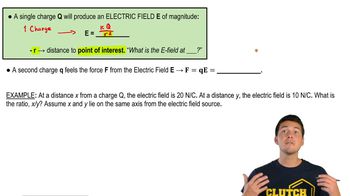
Electric Field due to a Point Charge

Surface Charge Density

Surface charge density (σ) is defined as the amount of charge per unit area on a surface. In this context, the surface charge density h represents how much charge is distributed over the area of the sheet. It is crucial for calculating the electric field produced by the sheet, as it directly influences the strength of the electric field in the surrounding space.
Recommended video:
Guided course
04:03
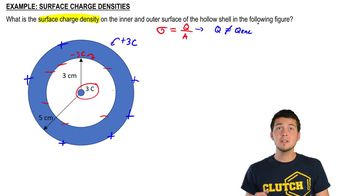
Surface Charge Density

Graphing Electric Field Strength

When graphing the electric field strength (E) versus position (x), it is important to note that for x > L/2, the electric field remains constant and directed away from the sheet. The graph will show a horizontal line at the value of E = h/(2ε₀) for x > L/2, indicating that the electric field does not change with increasing distance from the sheet in this region.
Recommended video:
Guided course
03:16
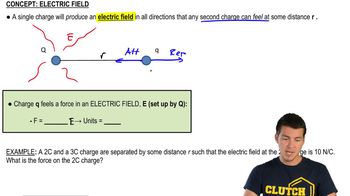
Intro to Electric Fields
Related Practice
Textbook Question

A rod of length L lies along the y-axis with its center at the origin. The rod has a nonuniform linear charge density λ=ay λ=a|y|, where a is a constant with the units C/m2. Find the electric field strength of the rod at distance x on the x-axis.

Textbook Question

A proton orbits a long charged wire, making 1.0×1061.0×10^6 revolutions per second. The radius of the orbit is 1.01.0 cm. What is the wire's linear charge density?

2
views
Textbook Question

A rod of length LL lies along the yy-axis with its center at the origin. The rod has a nonuniform linear charge density λ=ay λ=a|y|, where a is a constant with the units C/m2. Draw a graph of λλ versus yy over the length of the rod.

1
views
Textbook Question

One type of ink-jet printer, called an electrostatic ink-jet printer, forms the letters by using deflecting electrodes to steer charged ink drops up and down vertically as the ink jet sweeps horizontally across the page. The ink jet forms 30-μm-diameter drops of ink, charges them by spraying 800,000 electrons on the surface, and shoots them toward the page at a speed of 20 m/s . Along the way, the drops pass through two horizontal, parallel electrodes that are 6.0 mm long, 4.0 mm wide, and spaced 1.0 mm apart. The distance from the center of the electrodes to the paper is 2.0 cm. To form the tallest letters, which have a height of 6.0 mm, the drops need to be deflected upward (or downward) by 3.0 mm. What electric field strength is needed between the electrodes to achieve this deflection? Ink, which consists of dye particles suspended in alcohol, has a density of 800 kg/m3.

1
views
Textbook Question

A rod of length LL lies along the yy-axis with its center at the origin. The rod has a nonuniform linear charge density λ=ay λ=a|y|, where a is a constant with the units C/m2. Determine the constant a in terms of LL and the rod's total charge QQ.

1
views