
Ch 17: Superposition
Knight Calc - Physics for Scientists and Engineers 5th Edition
Knight Calc5th EditionPhysics for Scientists and EngineersISBN: 9780137344796Not the one you use?Change textbook
Chapter 17, Problem 55

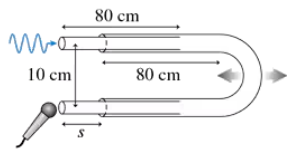
A 280 Hz sound wave is directed into one end of the trombone slide seen in FIGURE P17.55. A microphone is placed at the other end to record the intensity of sound waves that are transmitted through the tube. The straight sides of the slide are 80 cm in length and 10 cm apart with a semicircular bend at the end. For what slide extensions s will the microphone detect a maximum of sound intensity?

Verified step by step guidance
1
Step 1: Understand the problem. The sound wave will resonate in the trombone slide when the length of the slide corresponds to a multiple of the wavelength of the sound wave. The goal is to find the slide extensions 's' that result in maximum sound intensity, which occurs at resonance.
Step 2: Calculate the wavelength of the sound wave. The frequency of the sound wave is given as 280 Hz. Use the formula for the speed of sound in air, v = f * λ, where v is the speed of sound (approximately 343 m/s at room temperature), f is the frequency, and λ is the wavelength. Rearrange the formula to solve for λ: λ = v / f.
Step 3: Determine the total length of the trombone slide. The trombone slide consists of two straight sections, each 80 cm long, and a semicircular bend with a diameter of 15 cm. The length of the semicircular bend is half the circumference of a circle, calculated as π * diameter. Add these lengths together to find the total length of the slide without extension.
Step 4: Account for the variable slide extension 's'. The total length of the trombone slide becomes L_total = L_straight + L_semi + s, where L_straight is the combined length of the straight sections, L_semi is the length of the semicircular bend, and 's' is the variable extension.
Step 5: Set up the resonance condition. Resonance occurs when the total length of the slide corresponds to a multiple of half the wavelength, i.e., L_total = n * (λ / 2), where n is an integer (1, 2, 3, ...). Solve for 's' by substituting the values of L_straight, L_semi, and λ into the equation and finding the values of 's' that satisfy the resonance condition.

Verified video answer for a similar problem:

This video solution was recommended by our tutors as helpful for the problem above.
Video duration:
5m
Was this helpful?

Key Concepts

Here are the essential concepts you must grasp in order to answer the question correctly.

Sound Waves

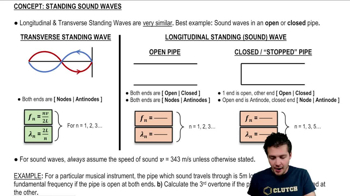
Sound waves are longitudinal waves that propagate through a medium, such as air, by compressing and rarefying the particles in the medium. The frequency of a sound wave, measured in hertz (Hz), determines its pitch. In this scenario, a 280 Hz sound wave is introduced into the trombone slide, which will influence how the wave interacts with the tube's dimensions.
Recommended video:
Guided course
05:17
Standing Sound Waves

Resonance

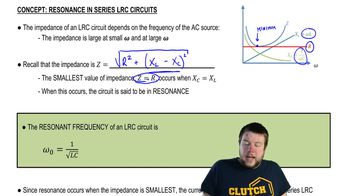
Resonance occurs when a system is driven at its natural frequency, leading to an increase in amplitude. In the context of the trombone slide, certain lengths of the slide will correspond to specific wavelengths of the sound wave, resulting in constructive interference and maximum sound intensity at the microphone. Understanding the relationship between the length of the slide and the wavelength is crucial for determining the slide extensions that produce resonance.
Recommended video:
Guided course
05:23
Resonance in Series LRC Circuits

Wavelength and Frequency Relationship

The relationship between wavelength (λ), frequency (f), and the speed of sound (v) is given by the equation v = fλ. For sound waves in air, the speed of sound is approximately 343 m/s at room temperature. By knowing the frequency of the sound wave (280 Hz), one can calculate the wavelength, which is essential for determining the conditions under which maximum sound intensity will be detected at the microphone.
Recommended video:
Guided course
05:08
Circumference, Period, and Frequency in UCM
Related Practice
Textbook Question

BIO Deep-sea divers often breathe a mixture of helium and oxygen to avoid getting the 'bends' from breathing high-pressure nitrogen. The helium has the side effect of making the divers' voices sound odd. Although your vocal tract can be roughly described as an open-closed tube, the way you hold your mouth and position your lips greatly affects the standing-wave frequencies of the vocal tract. This is what allows different vowels to sound different. The 'ee' sound is made by shaping your vocal tract to have standing-wave frequencies at, normally, 270 Hz and 2300 Hz. What will these frequencies be for a helium-oxygen mixture in which the speed of sound at body temperature is 750m/s ? The speed of sound in air at body temperature is 350m/s .

1
views
Textbook Question

In a laboratory experiment, one end of a horizontal string is tied to a support while the other end passes over a frictionless pulley and is tied to a 1.5 kg sphere. Students determine the frequencies of standing waves on the horizontal segment of the string, then they raise a beaker of water until the hanging 1.5 kg sphere is completely submerged. The frequency of the fifth harmonic with the sphere submerged exactly matches the frequency of the third harmonic before the sphere was submerged. What is the diameter of the sphere?

1
views
Textbook Question

A string under tension has a fundamental frequency of 220 Hz. What is the fundamental frequency if the tension is doubled?

2
views
Textbook Question

Two loudspeakers emit sound waves of the same frequency along the x-axis. The amplitude of each wave is a. The sound intensity is minimum when speaker 2 is 10 cm behind speaker 1. The intensity increases as speaker 2 is moved forward and first reaches maximum, with amplitude 2a, when it is 30 cm in front of speaker 1. What is The amplitude of the sound (as a multiple of a) if the speakers are placed side by side?

2
views
Textbook Question

An old mining tunnel disappears into a hillside. You would like to know how long the tunnel is, but it's too dangerous to go inside. Recalling your recent physics class, you decide to try setting up standing-wave resonances inside the tunnel. Using your subsonic amplifier and loudspeaker, you find resonances at 4.5 Hz and 6.3 Hz, and at no frequencies between these. It's rather chilly inside the tunnel, so you estimate the sound speed to be 335 m/s . Based on your measurements, how far is it to the end of the tunnel?

Textbook Question

A 1.0-m-tall vertical tube is filled with 20°C water. A tuning fork vibrating at 580 Hz is held just over the top of the tube as the water is slowly drained from the bottom. At what water heights, measured from the bottom of the tube, will there be a standing wave in the tube above the water?

1
views