Ch 23: The Electric Field
Knight Calc - Physics for Scientists and Engineers 5th Edition
Knight Calc5th EditionPhysics for Scientists and EngineersISBN: 9780137344796Not the one you use?Change textbook
Chapter 23, Problem 19

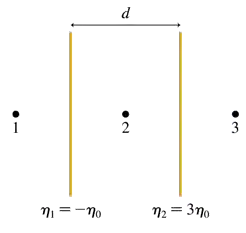
You’ve hung two very large sheets of plastic facing each other with distance d between them, as shown in FIGURE EX23.19. By rubbing them with wool and silk, you’ve managed to give one sheet a uniform surface charge density η1=η0η_1=−η_0 and the other a uniform surface charge density η2=+3η0η_2=+3η_0. What are the electric field vectors at points 1, 2, and 3?
Illustration of two charged sheets with points 1, 2, and 3 marked, showing electric field vectors and distance d between sheets.

Verified step by step guidance
1
Understand the problem: Two large sheets of plastic are facing each other with a distance d between them. Each sheet has a uniform surface charge density: η₁ = -η₀ for one sheet and η₂ = +3η₀ for the other. We need to determine the electric field vectors at three points: 1 (to the left of the sheets), 2 (between the sheets), and 3 (to the right of the sheets).
Recall the formula for the electric field due to a uniformly charged infinite sheet: The electric field produced by a single sheet with surface charge density η is given by E = η / (2ε₀), where ε₀ is the permittivity of free space. The direction of the field depends on the sign of the charge: it points away from a positively charged sheet and toward a negatively charged sheet.
Analyze the electric field contributions at each point: At point 1 (to the left of both sheets), the field from the negatively charged sheet (η₁ = -η₀) points toward the sheet, while the field from the positively charged sheet (η₂ = +3η₀) points away from it. These fields are in opposite directions, so their magnitudes will subtract.
At point 2 (between the sheets), the field from the negatively charged sheet (η₁ = -η₀) points toward the sheet (to the right), and the field from the positively charged sheet (η₂ = +3η₀) also points away from it (to the right). These fields are in the same direction, so their magnitudes will add.
At point 3 (to the right of both sheets), the field from the negatively charged sheet (η₁ = -η₀) points toward the sheet (to the left), while the field from the positively charged sheet (η₂ = +3η₀) points away from it (to the right). These fields are in opposite directions, so their magnitudes will subtract. Use the formula E = η / (2ε₀) to calculate the individual contributions and combine them appropriately for each point.

Verified video answer for a similar problem:

This video solution was recommended by our tutors as helpful for the problem above.
Video duration:
8m
Was this helpful?

Key Concepts

Here are the essential concepts you must grasp in order to answer the question correctly.

Electric Field

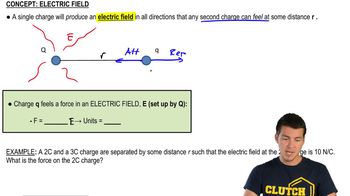
The electric field is a vector field that represents the force exerted by an electric charge on other charges in its vicinity. It is defined as the force per unit charge and is directed away from positive charges and toward negative charges. The strength and direction of the electric field can be calculated using Coulomb's law, which describes how charges interact with one another.
Recommended video:
Guided course
03:16
Intro to Electric Fields

Surface Charge Density

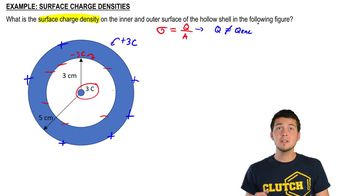
Surface charge density (η) is a measure of the amount of electric charge per unit area on a surface. It is expressed in coulombs per square meter (C/m²). In this scenario, the two sheets have different surface charge densities, which will influence the resulting electric fields between and around them, as the distribution of charge affects the strength and direction of the electric field.
Recommended video:
Guided course
04:03
Surface Charge Density

Superposition Principle

The superposition principle states that the total electric field created by multiple charges is the vector sum of the electric fields produced by each charge individually. This principle is crucial for analyzing systems with multiple charge distributions, such as the two charged sheets in this problem, as it allows us to calculate the resultant electric field at various points by considering the contributions from each sheet separately.
Recommended video:
Guided course
03:32
Superposition of Sinusoidal Wave Functions
Related Practice
Textbook Question

FIGURE EX23.25 shows a 1.51.5 g ball hanging from a string inside a parallel-plate capacitor made with 12 cm × 12 cm electrodes. The electrodes are charged to±75 nC. What is the charge on the ball in nC?

23
views

Textbook Question

Two 10-cm-diameter charged rings face each other, 20 cm apart. The left ring is charged to −20 nC and the right ring is charged to +20 nC. What is the force on a proton at the midpoint?

1
views
Textbook Question

Air 'breaks down' when the electric field strength reaches 3.0×10⁶ N/C, causing a spark. A parallel-plate capacitor is made from two 4.0 cm×4.0 cm electrodes. How many electrons must be transferred from one electrode to the other to create a spark between the electrodes?

1
views
Textbook Question

Two 10-cm-diameter charged disks face each other, 20 cm apart. The left disk is charged to −50 nC and the right disk is charged to +50 nC. a. What is the electric field Ē, both magnitude and direction, at the midpoint between the two disks?

3
views
Textbook Question

Two 2.0-cm-diameter disks face each other, 1.0 mm apart. They are charged to ±10 nC. A proton is shot from the negative disk toward the positive disk. What launch speed must the proton have to just barely reach the positive disk?

1
views
Textbook Question

Two 10-cm-diameter charged rings face each other, 20 cm apart. The left ring is charged to −20 nC and the right ring is charged to +20 nC. What is the electric field Ē, both magnitude and direction, at the midpoint between the two rings?

1
views