Ch. 18 - Kinetic Theory of Gases
Giancoli Douglas - Physics for Scientists and Engineers 5th edition
Giancoli Douglas5th editionPhysics for Scientists and EngineersISBN: 9780137488179Not the one you use?Change textbook
Chapter 18, Problem 22a

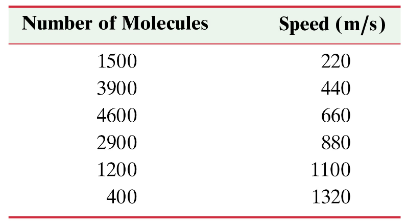
A gas consisting of 14,500 molecules, each of mass 2.00 x 10⁻²⁶ kg, has the following distribution of speeds, which crudely mimics the Maxwell distribution. Determine vᵣₘₛ for this distribution of speeds.
Table showing the distribution of speeds for 14,500 gas molecules, with corresponding counts at various speeds in m/s.

Verified step by step guidance
1
Identify the formula for the root-mean-square (rms) speed, which is given by: nivi2ni, where ni is the number of molecules at a given speed vi.
Extract the data from the distribution of speeds provided in the problem. For each speed vi, note the corresponding number of molecules ni. This information is necessary to calculate the numerator and denominator of the formula.
Calculate the numerator of the formula, which is the sum of the products of the number of molecules and the square of their respective speeds: nivi2. For each speed, square the speed value, multiply it by the corresponding number of molecules, and then sum these products.
Calculate the denominator of the formula, which is the total number of molecules: ni. Add up all the values of ni to find the total number of molecules in the distribution.
Divide the numerator by the denominator and take the square root to find the root-mean-square speed: nivi2ni. This will give the value of vrms.

Verified video answer for a similar problem:

This video solution was recommended by our tutors as helpful for the problem above.
Video duration:
4m
Was this helpful?

Key Concepts

Here are the essential concepts you must grasp in order to answer the question correctly.

Maxwell-Boltzmann Distribution

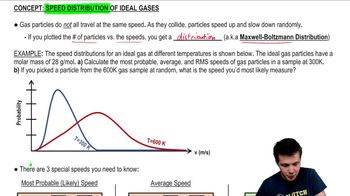
The Maxwell-Boltzmann distribution describes the distribution of speeds of particles in a gas at thermal equilibrium. It shows that most particles have speeds around a certain value, with fewer particles having very high or very low speeds. This statistical distribution is fundamental in understanding the kinetic theory of gases and how temperature affects molecular motion.
Recommended video:
Guided course
07:59
Speed Distribution & Special Speeds of Ideal Gases

Root Mean Square Speed (vᵣₘₛ)

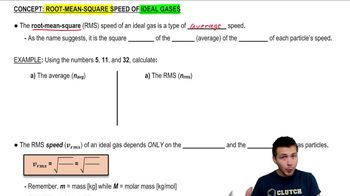
The root mean square speed (vᵣₘₛ) is a measure of the average speed of particles in a gas, calculated as the square root of the average of the squares of the speeds of all particles. It provides insight into the kinetic energy of the gas molecules and is essential for relating temperature to molecular motion in the context of kinetic theory.
Recommended video:
Guided course
05:21
Root-Mean-Square Speed of Ideal Gases

Kinetic Theory of Gases

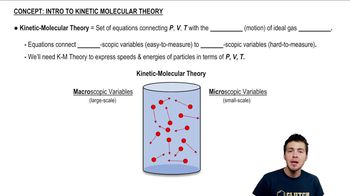
The kinetic theory of gases explains the behavior of gases in terms of the motion of their molecules. It posits that gas pressure arises from collisions of molecules with the walls of a container and that temperature is a measure of the average kinetic energy of the molecules. This theory underpins many concepts in thermodynamics and statistical mechanics.
Recommended video:
Guided course
01:50
Introduction to Kinetic-Molecular Theory