
Ch 16: Sound & Hearing
Young & Freedman Calc - University Physics 14th Edition
Young & Freedman Calc14th EditionUniversity PhysicsISBN: 9780321973610Not the one you use?Change textbook
Chapter 16, Problem 50b

A railroad train is traveling at 30.0 m/s in still air. The frequency of the note emitted by the train whistle is 352 Hz. What frequency is heard by a passenger on a train moving in the opposite direction to the first at 18.0 m/s and receding from the first?

Verified step by step guidance
1
Identify the problem as a Doppler effect scenario, where the frequency of a sound changes due to the relative motion between the source and the observer.
Use the Doppler effect formula for sound: \( f' = f \frac{v + v_o}{v + v_s} \), where \( f' \) is the observed frequency, \( f \) is the source frequency, \( v \) is the speed of sound in air (approximately 343 m/s at room temperature), \( v_o \) is the speed of the observer, and \( v_s \) is the speed of the source.
For part (a), where the observer is moving towards the source, set \( v_o = 18.0 \text{ m/s} \) and \( v_s = 30.0 \text{ m/s} \). Substitute these values into the formula: \( f' = 352 \text{ Hz} \times \frac{343 + 18}{343 - 30} \).
For part (b), where the observer is receding from the source, set \( v_o = -18.0 \text{ m/s} \) (since the observer is moving away) and \( v_s = 30.0 \text{ m/s} \). Substitute these values into the formula: \( f' = 352 \text{ Hz} \times \frac{343 - 18}{343 - 30} \).
Calculate the observed frequencies for both scenarios using the substituted values in the Doppler effect formula to find the frequencies heard by the passenger in each case.

Verified video answer for a similar problem:

This video solution was recommended by our tutors as helpful for the problem above.
Video duration:
4m
Was this helpful?

Key Concepts

Here are the essential concepts you must grasp in order to answer the question correctly.

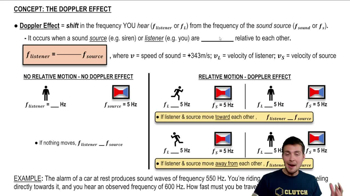
Doppler Effect

The Doppler Effect describes the change in frequency or wavelength of a wave in relation to an observer moving relative to the wave source. In this scenario, the frequency of the train whistle changes as perceived by a passenger on another train moving in the opposite direction, due to their relative motion.
Recommended video:
Guided course
07:40
The Doppler Effect

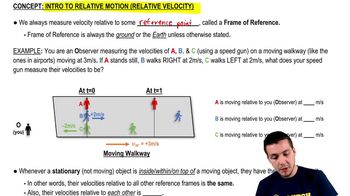
Relative Velocity

Relative velocity is the velocity of an object as observed from a particular reference frame, and it is crucial for calculating the perceived frequency in the Doppler Effect. Here, the relative velocity between the two trains affects the frequency heard by the passenger, as it determines the rate at which the distance between the source and observer changes.
Recommended video:
Guided course
04:27
Intro to Relative Motion (Relative Velocity)

Wave Frequency

Wave frequency refers to the number of oscillations or cycles per unit time, measured in Hertz (Hz). The original frequency of the train whistle is 352 Hz, and understanding how this frequency is altered by the Doppler Effect due to the relative motion of the trains is essential for solving the problem.
Recommended video:
Guided course
05:08
Circumference, Period, and Frequency in UCM
Related Practice
Textbook Question

The siren of a fire engine that is driving northward at 30.0 m/s emits a sound of frequency 2000 Hz. A truck in front of this fire engine is moving northward at 20.0 m/s. What wavelength would this driver measure for these reflected sound waves?

2
views
Textbook Question

A railroad train is traveling at 30.0 m/s in still air. The frequency of the note emitted by the train whistle is 352 Hz. What frequency is heard by a passenger on a train moving in the opposite direction to the first at 18.0 m/s and approaching the first?

2
views
Textbook Question

The shock-wave cone created by a space shuttle at one instant during its reentry into the atmosphere makes an angle of 58.0° with its direction of motion. The speed of sound at this altitude is 331 m/s. What is the Mach number of the shuttle at this instant?

1
views
Textbook Question

The motors that drive airplane propellers are, in some cases, tuned by using beats. The whirring motor produces a sound wave having the same frequency as the propeller. (a) If one single-bladed propeller is turning at 575 rpm and you hear 2.0-Hz beats when you run the second propeller, what are the two possible frequencies (in rpm) of the second propeller? (b) Suppose you increase the speed of the second propeller slightly and find that the beat frequency changes to 2.1 Hz. In part (a), which of the two answers was the correct one for the frequency of the second single-bladed propeller? How do you know?

1
views
Textbook Question

Two organ pipes, open at one end but closed at the other, are each 1.14 m long. One is now lengthened by 2.00 cm. Find the beat frequency that they produce when playing together in their fundamentals.

2
views
Textbook Question

The siren of a fire engine that is driving northward at 30.0 m/s emits a sound of frequency 2000 Hz. A truck in front of this fire engine is moving northward at 20.0 m/s. (a) What is the frequency of the siren's sound that the fire engine's driver hears reflected from the back of the truck?

4
views