Ch 13: Newton's Theory of Gravity
Knight Calc - Physics for Scientists and Engineers 5th Edition
Knight Calc5th EditionPhysics for Scientists and EngineersISBN: 9780137344796Not the one you use?Change textbook
Chapter 13, Problem 8

What is the free-fall acceleration at the surface of (a) the moon and (b) Jupiter?

Verified step by step guidance
1
Identify the formula for gravitational acceleration: g=(G)(M)r2, where G is the gravitational constant, M is the mass of the celestial body, and r is the radius of the celestial body.
For part (a), substitute the values for the moon: M=7.35×10²² kg and r=1.74×10⁶ m. Plug these into the formula to calculate the free-fall acceleration on the moon.
For part (b), substitute the values for Jupiter: M=1.90×1027 kg and r=6.99×10⁷ m. Plug these into the formula to calculate the free-fall acceleration on Jupiter.
Simplify the expression for each case by performing the operations in the numerator and denominator separately, then divide the results. Ensure the units are consistent throughout the calculation.
Interpret the results: The calculated values represent the free-fall acceleration at the surface of the moon and Jupiter, respectively. These values indicate how quickly an object would accelerate due to gravity if dropped from rest on each celestial body.

Verified video answer for a similar problem:

This video solution was recommended by our tutors as helpful for the problem above.
Video duration:
3m
Was this helpful?

Key Concepts

Here are the essential concepts you must grasp in order to answer the question correctly.

Free-Fall Acceleration

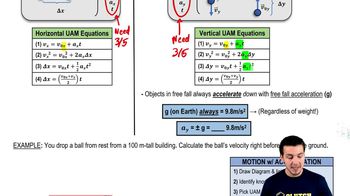
Free-fall acceleration refers to the acceleration of an object due solely to the influence of gravity, without any other forces acting on it. On Earth, this acceleration is approximately 9.81 m/s². However, this value varies depending on the mass and radius of the celestial body in question, as gravitational force is directly proportional to mass and inversely proportional to the square of the distance from the center of the mass.
Recommended video:
Guided course
08:36
Vertical Motion & Free Fall

Gravitational Force

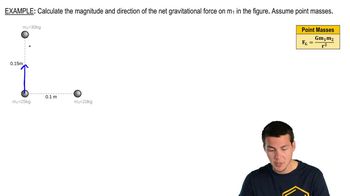
Gravitational force is the attractive force that exists between any two masses. It is described by Newton's law of universal gravitation, which states that the force is proportional to the product of the two masses and inversely proportional to the square of the distance between their centers. This principle helps calculate the gravitational acceleration on different celestial bodies, such as the Moon and Jupiter.
Recommended video:
Guided course
05:41
Gravitational Forces in 2D

Celestial Body Characteristics

The characteristics of a celestial body, such as its mass and radius, significantly influence its gravitational pull. For instance, the Moon has a smaller mass and radius compared to Earth, resulting in a lower free-fall acceleration of about 1.62 m/s². In contrast, Jupiter, being the largest planet in the solar system, has a much greater mass, leading to a free-fall acceleration of approximately 24.79 m/s² at its cloud tops.
Recommended video:
Guided course
08:42
Free-Body Diagrams