Ch. 28 - Sources of Magnetic Field
Giancoli Douglas - Physics for Scientists and Engineers 5th edition
Giancoli Douglas5th editionPhysics for Scientists and EngineersISBN: 9780137488179Not the one you use?Change textbook
Chapter 27, Problem 49

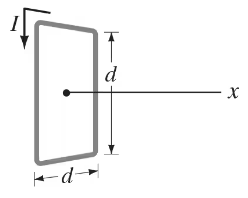
(III) A square loop of wire, of side d, carries a current I. (a) Determine the magnetic field B at points on a line (call it the 𝓍 axis) perpendicular to the plane of the square which passes through the center of the square (Fig. 28–56). Express B as a function of 𝓍, the distance from the center of the square. (b) For 𝓍 ≫ d, does the square appear to be a magnetic dipole? If so, what is its dipole moment?


Verified step by step guidance
1
Step 1: Begin by understanding the geometry of the problem. The square loop of wire has a side length 'd' and carries a current 'I'. The goal is to calculate the magnetic field 'B' at points along the 𝓍-axis, which is perpendicular to the plane of the square and passes through its center.
Step 2: Use the Biot-Savart law to calculate the magnetic field contribution from each segment of the square loop. The Biot-Savart law states: B=ΞΌ0I4Ο€dl×rr3. Here, 'dl' is the infinitesimal length of the wire, 'r' is the distance vector from the wire to the point of interest, and ΞΌβ‚€ is the permeability of free space.
Step 3: Recognize the symmetry of the square loop. Due to the symmetry, the contributions to the magnetic field from opposite sides of the square will partially cancel out in certain directions. Focus on the components of the field along the 𝓍-axis, as other components will cancel due to symmetry.
Step 4: For part (b), analyze the behavior of the magnetic field when 𝓍 ≫ d. In this limit, the square loop can be approximated as a magnetic dipole. The magnetic dipole moment 'm' is given by: m=I×A, where 'A' is the area of the square loop. Since the area of the square is d2, the dipole moment becomes m=I×d2.
Step 5: Conclude by noting that for large distances (𝓍 ≫ d), the magnetic field of the square loop resembles that of a magnetic dipole. The field can be expressed using the dipole field formula: B=ΞΌ0m4Ο€x3, where 'm' is the dipole moment and 'x' is the distance from the center of the square.

Verified video answer for a similar problem:

This video solution was recommended by our tutors as helpful for the problem above.
Video duration:
6m
Was this helpful?

Key Concepts

Here are the essential concepts you must grasp in order to answer the question correctly.

Magnetic Field Due to a Current Loop

The magnetic field generated by a current-carrying loop of wire can be calculated using the Biot-Savart law. This law states that the magnetic field at a point in space is proportional to the current flowing through the wire and inversely proportional to the square of the distance from the wire to the point. For a square loop, the magnetic field can be derived by integrating contributions from each segment of the loop.
Recommended video:
Guided course
13:54
Magnetic Field Produced by Loops and Solenoids

Magnetic Dipole Moment

The magnetic dipole moment is a vector quantity that represents the strength and orientation of a magnetic source. For a current loop, it is defined as the product of the current flowing through the loop and the area of the loop. In the case of a square loop, the dipole moment can be calculated as ΞΌ = I * A, where A is the area of the square, which is dΒ² for a square of side length d.
Recommended video:
Guided course
03:08
Intro To Dipole Moment

Limit of Large Distance (𝓍 ≫ d)

When analyzing the magnetic field at points far away from a current loop (where the distance 𝓍 is much greater than the dimensions of the loop, d), the loop can be approximated as a magnetic dipole. In this limit, the magnetic field behaves similarly to that of a point dipole, allowing for simplifications in calculations and leading to the conclusion that the field decreases with distance as 1/𝓍³.
Recommended video:
Guided course
07:59
Magnetic Field due to Finite Wire
Related Practice
Textbook Question

(III) Use the result of Problem 44 to find the magnetic field at point P in Fig. 28–53 due to the current in the square loop.


1
views

Textbook Question

A long horizontal wire carries a current of 42 A. A second wire, made of 1.00-mm-diameter copper wire and parallel to the first, is kept in suspension magnetically 5.0 cm below (Fig. 28–60). (a) Determine the magnitude and direction of the current in the lower wire. (b) Is the lower wire in stable equilibrium? (c) Repeat parts (a) and (b) if the second wire is suspended 5.0 cm above the first due to the first’s magnetic field.

1
views
Textbook Question

In Fig. 28–57 the top wire is 1.00-mm-diameter copper wire and is suspended in air due to the two magnetic forces from the bottom two wires. The current is 35.0 A in each of the two bottom wires. Calculate the required current in the suspended wire (M).

1
views
Textbook Question

Three long parallel wires are 3.5 cm from one another. (Looking along them, they are at three corners of an equilateral triangle.) The current in each wire is 9.50 A, but its direction in wire M is opposite to that in wires N and P (Fig. 28–57). Determine the magnetic force per unit length on each wire due to the other two.


1
views
Textbook Question

(II) Consider a straight section of wire of length d, as in Fig. 28–51, which carries a current I. (a) Show that the magnetic field at a point P a distance 𝑅 from the wire along its perpendicular bisector is


B=ΞΌ0I2Ο€Rd(d2+4R2)12B = \(\frac{\mu_0 I}{2\pi R}\) \(\frac{d}{(d^2 + 4R^2)^{\frac{1}{2}\)}}


(b) Show that this is consistent with Example 28–10 for an infinite wire.

1
views
Textbook Question

(II) A wire is formed into the shape of two half circles connected by equal-length straight sections as shown in Fig. 28–48. A current I flows in the circuit clockwise as shown. Determine (a) the magnitude and direction of the magnetic field at the center, C, and (b) the magnetic dipole moment of the circuit.

2
views