Ch 22: Electric Charges and Forces
Knight Calc - Physics for Scientists and Engineers 5th Edition
Knight Calc5th EditionPhysics for Scientists and EngineersISBN: 9780137344796Not the one you use?Change textbook
Chapter 22, Problem 3a

A plastic rod that has been charged to −15 nC touches a metal sphere. Afterward, the rod's charge is −10 nC. What kind of charged particle was transferred between the rod and the sphere, and in which direction? That is, did it move from the rod to the sphere or from the sphere to the rod?

Verified step by step guidance
1
Understand the nature of charge transfer: In this scenario, the rod is negatively charged, meaning it has an excess of electrons. When the rod touches the metal sphere, charge transfer occurs due to the conductive nature of the sphere.
Determine the type of particle transferred: Since the rod is negatively charged, the only type of charged particle that can move is the electron. Electrons are responsible for negative charge transfer.
Analyze the change in charge on the rod: Initially, the rod had a charge of −15 nC, and after touching the sphere, its charge decreased to −10 nC. This indicates that the rod lost 5 nC of negative charge.
Identify the direction of transfer: The decrease in negative charge on the rod means electrons moved from the rod to the sphere. This transfer reduced the rod's excess negative charge.
Summarize the findings: Electrons were transferred from the rod to the sphere, resulting in a decrease in the rod's negative charge and an increase in the sphere's negative charge.

Verified video answer for a similar problem:

This video solution was recommended by our tutors as helpful for the problem above.
Video duration:
3m
Was this helpful?

Key Concepts

Here are the essential concepts you must grasp in order to answer the question correctly.

Charge Transfer

Charge transfer occurs when charged objects come into contact, allowing electrons to move between them. In this scenario, the plastic rod, initially negatively charged, loses some of its negative charge when it touches the metal sphere, indicating that electrons are transferred from the rod to the sphere.
Recommended video:
Guided course
05:14
Overview of Heat Transfer

Types of Charge

There are two types of electric charge: positive and negative. Electrons carry a negative charge, while protons carry a positive charge. In this case, the plastic rod is negatively charged, and the metal sphere, being neutral initially, gains negative charge when electrons are transferred from the rod.
Recommended video:
Guided course
04:47
Overview of Collision Types

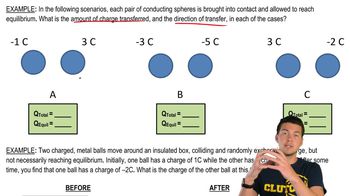
Conservation of Charge

The principle of conservation of charge states that the total electric charge in an isolated system remains constant. When the rod loses charge, the sphere gains an equal amount, ensuring that the overall charge is conserved. This principle helps explain the final charges of both objects after contact.
Recommended video:
Guided course
05:43
Conservation of Charge