
Ch 20: The Second Law of Thermodynamics
Young & Freedman Calc - University Physics 14th Edition
Young & Freedman Calc14th EditionUniversity PhysicsISBN: 9780321973610Not the one you use?Change textbook
Chapter 20, Problem 17b

A Carnot refrigerator is operated between two heat reservoirs at temperatures of 320320 K and 270270 K. If the refrigerator completes 165165 cycles each minute, what power input is required to operate it?

Verified step by step guidance
1
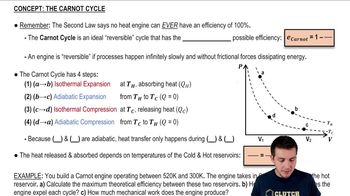
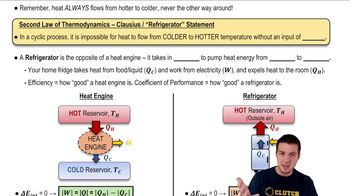
Understand the concept of a Carnot refrigerator: A Carnot refrigerator is a theoretical model that operates on the Carnot cycle, which is the most efficient cycle possible for a heat engine or refrigerator. It transfers heat from a colder reservoir to a hotter reservoir.
Identify the temperatures of the heat reservoirs: The refrigerator operates between two reservoirs at temperatures \( T_H = 320 \text{ K} \) and \( T_C = 270 \text{ K} \).
Calculate the coefficient of performance (COP) for the Carnot refrigerator using the formula: \( \text{COP} = \frac{T_C}{T_H - T_C} \). Substitute the given temperatures into this formula.
Determine the work input per cycle using the relationship between COP and work: \( \text{COP} = \frac{Q_C}{W} \), where \( Q_C \) is the heat extracted from the cold reservoir and \( W \) is the work input. Rearrange to find \( W = \frac{Q_C}{\text{COP}} \).
Calculate the power input required: Since the refrigerator completes 165 cycles per minute, multiply the work input per cycle by the number of cycles per minute to find the total work per minute. Convert this to power by dividing by 60 seconds to get the power in watts.

Verified video answer for a similar problem:

This video solution was recommended by our tutors as helpful for the problem above.
Video duration:
5m
Was this helpful?

Key Concepts

Here are the essential concepts you must grasp in order to answer the question correctly.

Carnot Cycle

The Carnot cycle is a theoretical thermodynamic cycle that provides the maximum possible efficiency for a heat engine or refrigerator operating between two temperatures. It consists of two isothermal processes and two adiabatic processes. For a refrigerator, it describes the idealized process of extracting heat from a cold reservoir and expelling it to a hot reservoir.
Recommended video:
Guided course
06:28
The Carnot Cycle and Maximum Theoretical Efficiency

Coefficient of Performance (COP)

The Coefficient of Performance (COP) is a measure of a refrigerator's efficiency, defined as the ratio of the heat removed from the cold reservoir to the work input required. For a Carnot refrigerator, the COP is given by the formula COP = T_c / (T_h - T_c), where T_c and T_h are the absolute temperatures of the cold and hot reservoirs, respectively. This helps determine the work needed for a given heat transfer.
Recommended video:
Guided course
06:47
Refrigerators

Power and Energy

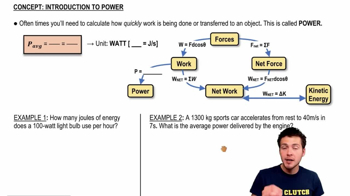
Power is the rate at which work is done or energy is transferred, measured in watts (W). In the context of a refrigerator, power input refers to the energy required per unit time to operate the refrigerator. Given the number of cycles per minute and the work per cycle, the power input can be calculated to determine the energy consumption of the refrigerator.
Recommended video:
Related Practice
Textbook Question

A Carnot refrigerator is operated between two heat reservoirs at temperatures of 320320 K and 270270 K. If in each cycle the refrigerator receives 415415 J of heat energy from the reservoir at 270270 K, how many joules of heat energy does it deliver to the reservoir at 320320 K?

3
views
Textbook Question

A Carnot refrigerator is operated between two heat reservoirs at temperatures of 320320 K and 270270 K. What is the coefficient of performance of the refrigerator?

2
views
Textbook Question

A certain brand of freezer is advertised to use 730730 kWh of energy per year. What is the theoretical maximum amount of ice this freezer could make in an hour, starting with water at 20.020.0°C?

1
views
Textbook Question

A certain brand of freezer is advertised to use 730730 kWh of energy per year. Assuming the freezer operates for 55 hours each day, how much power does it require while operating?

2
views
Textbook Question

A Carnot heat engine uses a hot reservoir consisting of a large amount of boiling water and a cold reservoir consisting of a large tub of ice and water. In 55 minutes of operation, the heat rejected by the engine melts 0.04000.0400 kg of ice. During this time, how much work WW is performed by the engine?

2
views
Textbook Question

A 4.504.50-kg block of ice at 0.000.00°C falls into the ocean and melts. The average temperature of the ocean is 3.503.50°C, including all the deep water. By how much does the change of this ice to water at 3.503.50°C alter the entropy of the world? Does the entropy increase or decrease? (Hint: Do you think that the ocean temperature will change appreciably as the ice melts?)

1
views