Ch 18: A Macroscopic Description of Matter
Knight Calc - Physics for Scientists and Engineers 5th Edition
Knight Calc5th EditionPhysics for Scientists and EngineersISBN: 9780137344796Not the one you use?Change textbook
Chapter 18, Problem 41

The molecular mass of water (H₂O) is 18 u. How many protons are there in 1.0 L of liquid water?

Verified step by step guidance
1
Step 1: Determine the number of molecules in 1.0 L of water. Start by finding the mass of 1.0 L of water using its density, which is approximately 1 g/mL. Since 1.0 L is equivalent to 1000 mL, the mass of water is 1000 g.
Step 2: Calculate the number of moles of water in 1000 g. Use the molecular mass of water, which is 18 u (or 18 g/mol). The number of moles is given by dividing the mass of water by its molecular mass: \( \text{moles} = \frac{\text{mass}}{\text{molecular mass}} \).
Step 3: Find the number of molecules of water using Avogadro's number, \( 6.022 \times 10^{23} \) molecules/mol. Multiply the number of moles by Avogadro's number: \( \text{molecules} = \text{moles} \times 6.022 \times 10^{23} \).
Step 4: Determine the number of protons in a single water molecule. A water molecule (H₂O) consists of 2 hydrogen atoms and 1 oxygen atom. Each hydrogen atom has 1 proton, and the oxygen atom has 8 protons, so a single water molecule contains \( 2 + 8 = 10 \) protons.
Step 5: Calculate the total number of protons in 1.0 L of water by multiplying the number of water molecules by the number of protons per molecule: \( \text{total protons} = \text{molecules} \times 10 \).

Verified video answer for a similar problem:

This video solution was recommended by our tutors as helpful for the problem above.
Video duration:
4m
Was this helpful?

Key Concepts

Here are the essential concepts you must grasp in order to answer the question correctly.

Molecular Mass

Molecular mass is the mass of a molecule calculated as the sum of the atomic masses of its constituent atoms. For water (H₂O), the molecular mass is approximately 18 atomic mass units (u), derived from 2 hydrogen atoms (1 u each) and 1 oxygen atom (16 u). This concept is essential for determining the number of molecules in a given mass of a substance.
Recommended video:
Guided course
01:50
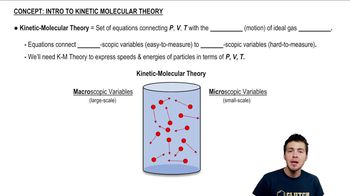
Introduction to Kinetic-Molecular Theory

Avogadro's Number

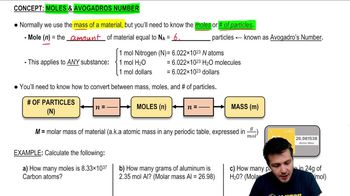
Avogadro's number, approximately 6.022 x 10²³, is the number of atoms, ions, or molecules in one mole of a substance. This constant allows us to convert between the mass of a substance and the number of molecules it contains. Understanding this concept is crucial for calculating the number of molecules in 1.0 L of water based on its molecular mass.
Recommended video:
Guided course
07:19
Moles & Avogadro's Number

Protons in Water Molecules

Each water molecule (H₂O) contains 2 hydrogen atoms and 1 oxygen atom. Hydrogen has 1 proton per atom, and oxygen has 8 protons. Therefore, each water molecule contains a total of 10 protons. Knowing the number of protons in a molecule is important for understanding the composition of substances and their chemical properties.
Recommended video:
Guided course
03:56
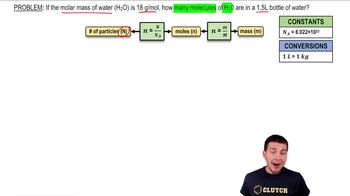
Calculating number of water molecules in a bottle