Ch 19: The First Law of Thermodynamics
Young & Freedman Calc - University Physics 14th Edition
Young & Freedman Calc14th EditionUniversity PhysicsISBN: 9780321973610Not the one you use?Change textbook
Chapter 19, Problem 13c

The pVpV-diagram in Fig. E19.1319.13 shows a process abcabc involving 0.4500.450 mol of an ideal gas. How much heat had to be added during the process to increase the internal energy of the gas by 15,00015,000 J?
pV-diagram illustrating process abc with points a, b, and c for an ideal gas.

Verified step by step guidance
1
Identify the process on the pV-diagram. The process abc involves a change in pressure and volume, indicating work done by or on the gas.
Use the first law of thermodynamics, which states that the change in internal energy (ΔU) is equal to the heat added to the system (Q) minus the work done by the system (W): ΔU = Q - W.
Given that the change in internal energy (ΔU) is 15,000 J, rearrange the equation to solve for the heat added (Q): Q = ΔU + W.
Calculate the work done (W) during the process. For a process on a pV-diagram, the work done is the area under the curve. In this case, calculate the area of the trapezoid formed by the process abc.
Substitute the calculated work (W) and the given change in internal energy (ΔU) into the equation Q = ΔU + W to find the heat added during the process.

Verified video answer for a similar problem:

This video solution was recommended by our tutors as helpful for the problem above.
Video duration:
6m
Was this helpful?

Key Concepts

Here are the essential concepts you must grasp in order to answer the question correctly.

Ideal Gas Law

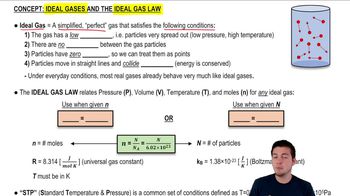
The Ideal Gas Law relates the pressure (p), volume (V), and temperature (T) of an ideal gas through the equation PV = nRT, where n is the number of moles and R is the ideal gas constant. This law is fundamental for understanding the behavior of gases under various conditions and is essential for calculating changes in state variables during thermodynamic processes.
Recommended video:
Guided course
07:21
Ideal Gases and the Ideal Gas Law

First Law of Thermodynamics

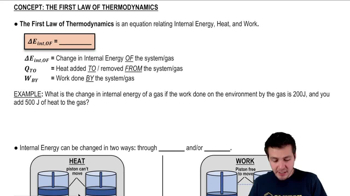
The First Law of Thermodynamics states that the change in internal energy (ΔU) of a system is equal to the heat added to the system (Q) minus the work done by the system (W), expressed as ΔU = Q - W. This principle is crucial for analyzing energy transfers in thermodynamic processes, such as the one depicted in the pV diagram.
Recommended video:
Guided course
08:04
The First Law of Thermodynamics

pV Diagram

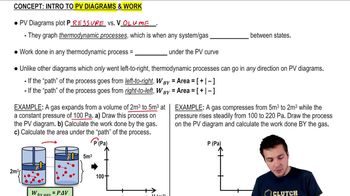
A pV diagram is a graphical representation of the relationship between pressure (p) and volume (V) for a thermodynamic process. It visually illustrates how the state of a gas changes during processes such as isothermal, isobaric, or adiabatic transformations, allowing for the analysis of work done and heat transfer during these processes.
Recommended video:
Guided course
08:07
Work and PV Diagrams
Related Practice
Textbook Question

Five moles of an ideal monatomic gas with an initial temperature of 127127°C expand and, in the process, absorb 15001500 J of heat and do 21002100 J of work. What is the final temperature of the gas?

1
views

Textbook Question

A gas in a cylinder is held at a constant pressure of 1.80×1051.80\(\times\)10^5 Pa and is cooled and compressed from 1.701.70 m3 to 1.201.20 m3. The internal energy of the gas decreases by 1.40×1051.40\(\times\)10^5 J. Does it matter whether the gas is ideal? Why or why not?

2
views
Textbook Question

When water is boiled at a pressure of 2.002.00 atm, the heat of vaporization is 2.20×1062.20\(\times\)10^6 J/kg and the boiling point is 120120°C. At this pressure, 1.001.00 kg of water has a volume of 1.00×1031.00\(\times\)10^{-3} m3, and 1.001.00 kg of steam has a volume of 0.8240.824 m3. Compute the increase in internal energy of the water.

3
views
Textbook Question

An ideal gas is taken from aa to bb on the pVpV-diagram shown in Fig. E19.1519.15. During this process, 700700 J of heat is added and the pressure doubles. How does the internal energy of the gas at aa compare to the internal energy at bb? Be specific and explain.

1
views
Textbook Question

The process abcabc shown in the pVpV-diagram in Fig. E19.1119.11 involves 0.01750.0175 mol of an ideal gas. What was the lowest temperature the gas reached in this process? Where did it occur?

3
views
Textbook Question

When water is boiled at a pressure of 2.002.00 atm, the heat of vaporization is 2.20×1062.20\(\times\)10^6 J/kg and the boiling point is 120120°C. At this pressure, 1.001.00 kg of water has a volume of 1.00×1031.00\(\times\)10^{-3} m3, and 1.001.00 kg of steam has a volume of 0.8240.824 m3. Compute the work done when 1.001.00 kg of steam is formed at this temperature.

1
views