
Ch 38: Quantization
Knight Calc - Physics for Scientists and Engineers 5th Edition
Knight Calc5th EditionPhysics for Scientists and EngineersISBN: 9780137344796Not the one you use?Change textbook
Chapter 38, Problem 44

A 75 kW radio transmitter emits 550 kHz radio waves uniformly in all directions. At what rate do photons strike a 1.5-m-tall, 3.0-mm-diameter antenna that is 15 km away?

Verified step by step guidance
1
Step 1: Calculate the energy of a single photon using the formula \( E = h \cdot f \), where \( h \) is Planck's constant \( (6.626 \times 10^{-34} \, \text{J·s}) \) and \( f \) is the frequency of the radio wave \( (550 \times 10^{3} \, \text{Hz}) \).
Step 2: Determine the total power emitted by the transmitter, which is given as \( P = 75 \, \text{kW} \) or \( 75 \times 10^{3} \, \text{W} \). This represents the energy emitted per second.
Step 3: Calculate the number of photons emitted per second using \( N = \frac{P}{E} \), where \( P \) is the total power and \( E \) is the energy of a single photon.
Step 4: Compute the intensity of the radio waves at a distance of \( r = 15 \, \text{km} \) using the formula \( I = \frac{P}{4 \pi r^2} \), where \( r \) is the distance from the transmitter. Convert \( r \) to meters before substituting.
Step 5: Calculate the rate at which photons strike the antenna by multiplying the intensity \( I \) by the cross-sectional area of the antenna \( A \), where \( A = \pi \cdot \left( \frac{d}{2} \right)^2 \) and \( d \) is the diameter of the antenna (3.0 mm converted to meters).

Verified video answer for a similar problem:

This video solution was recommended by our tutors as helpful for the problem above.
Was this helpful?

Key Concepts

Here are the essential concepts you must grasp in order to answer the question correctly.

Power and Energy of Photons

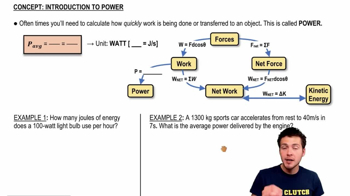
The power of a transmitter, measured in watts, indicates the rate at which it emits energy. Each photon carries energy determined by its frequency, given by the equation E = hf, where E is energy, h is Planck's constant, and f is frequency. Understanding the relationship between power and photon energy is essential for calculating the number of photons emitted per second.
Recommended video:

Intensity of Electromagnetic Waves

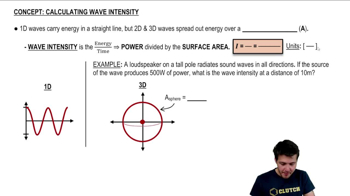
The intensity of an electromagnetic wave is defined as the power per unit area. It decreases with distance from the source according to the inverse square law, which states that intensity is proportional to 1/r², where r is the distance from the source. This concept is crucial for determining how many photons reach the antenna based on its distance from the transmitter.
Recommended video:
Guided course
02:32
Wave Intensity

Photon Flux

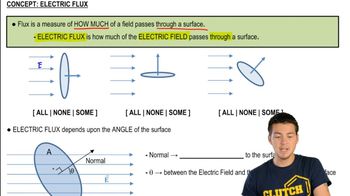
Photon flux refers to the number of photons passing through a given area per unit time. It can be calculated by dividing the intensity of the electromagnetic wave by the energy of a single photon. This concept is vital for finding the rate at which photons strike the antenna, as it directly relates the intensity of the radio waves to the physical dimensions of the antenna.
Recommended video:
Guided course
05:43
Electric Flux