Ch 13: Newton's Theory of Gravity
Knight Calc - Physics for Scientists and Engineers 5th Edition
Knight Calc5th EditionPhysics for Scientists and EngineersISBN: 9780137344796Not the one you use?Change textbook
Chapter 13, Problem 31b

The Parker Solar Probe, launched in 2018, was the first spacecraft to explore the solar corona, the hot gases and flares that extend outward from the solar surface. The probe is in a highly elliptical orbit that, using the gravity of Venus, will be nudged ever closer to the sun until, in 2025, it reaches a closest approach of 6.9 million kilometers from the center of the sun. Its maximum speed as it whips through the corona will be 192 km/s. The probe's highly elliptical orbit carries it out to a maximum distance of 160 Rs with a period of 88 days. What is its slowest speed, in km/s?

Verified step by step guidance
1
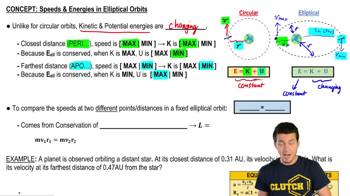
Step 1: Recognize that the problem involves an elliptical orbit, and the relationship between the speeds at the closest and farthest points of the orbit can be determined using the conservation of angular momentum. Angular momentum is conserved because no external torques act on the system.
Step 2: Write the expression for angular momentum conservation: \( m v_{min} r_{max} = m v_{max} r_{min} \), where \( m \) is the mass of the probe, \( v_{min} \) is the slowest speed, \( v_{max} \) is the maximum speed, \( r_{max} \) is the farthest distance from the center of the Sun, and \( r_{min} \) is the closest distance from the center of the Sun.
Step 3: Simplify the equation by canceling the mass \( m \), as it appears on both sides. This gives \( v_{min} r_{max} = v_{max} r_{min} \). Rearrange to solve for \( v_{min} \): \( v_{min} = \frac{v_{max} r_{min}}{r_{max}} \).
Step 4: Substitute the given values into the equation. The maximum speed \( v_{max} \) is 192 km/s, the closest distance \( r_{min} \) is 6.9 million kilometers (\( 6.9 \times 10^6 \) km), and the farthest distance \( r_{max} \) is 160 times the Sun's radius \( R_\odot \), where \( R_\odot = 6.96 \times 10^5 \) km. Thus, \( r_{max} = 160 \times 6.96 \times 10^5 \) km.
Step 5: Perform the substitution: \( v_{min} = \frac{192 \times (6.9 \times 10^6)}{160 \times (6.96 \times 10^5)} \). Simplify the expression to find \( v_{min} \), the slowest speed of the probe in km/s.

Verified video answer for a similar problem:

This video solution was recommended by our tutors as helpful for the problem above.
Video duration:
7m
Was this helpful?

Key Concepts

Here are the essential concepts you must grasp in order to answer the question correctly.

Elliptical Orbits

An elliptical orbit is a closed path around a central body, where the distance between the orbiting object and the central body varies. The shape of the orbit is defined by two focal points, one of which is occupied by the central body. In the case of the Parker Solar Probe, its highly elliptical orbit allows it to travel close to the Sun and then far away, utilizing gravitational assists from Venus to adjust its trajectory.
Recommended video:
Guided course
6:03
Speed and Energy of Elliptical Orbits

Kepler's Laws of Planetary Motion

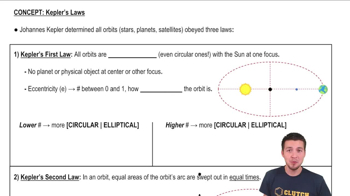
Kepler's Laws describe the motion of planets in their orbits around the Sun. The second law, known as the law of areas, states that a line segment joining a planet and the Sun sweeps out equal areas during equal intervals of time. This implies that the probe will move faster when it is closer to the Sun and slower when it is farther away, which is crucial for calculating its slowest speed at maximum distance.
Recommended video:
Guided course
05:43
Overview of Kepler's Laws

Conservation of Energy in Orbits

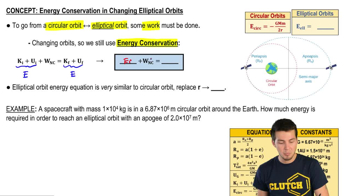
In orbital mechanics, the total mechanical energy of an orbiting body is conserved. This means that the sum of kinetic energy (due to speed) and potential energy (due to position in the gravitational field) remains constant. For the Parker Solar Probe, as it moves to its maximum distance from the Sun, its speed decreases, reflecting the conversion of kinetic energy into potential energy as it climbs out of the Sun's gravitational well.
Recommended video:
Guided course
8:09
Energy Conservation in Changing Elliptical Orbits