


Ch. 33 - Lenses and Optical Instruments
Giancoli Douglas - Physics for Scientists and Engineers 5th edition
Giancoli Douglas5th editionPhysics for Scientists and EngineersISBN: 9780137488179Not the one you use?Change textbook
Chapter 32, Problem 84

Figure 33–49 is a photograph of an eyeball with the image of a boy in a doorway. (a) Is the eye here acting as a lens or as a mirror? (b) Is the eye being viewed right side up or is the camera taking this photo upside down? (c) Explain, based on all possible images made by a convex mirror or lens.


<IMAGE>

Verified step by step guidance
1
Step 1: Analyze the function of the eye in the photograph. The eye acts as a lens because it refracts light to form an image on the retina. Unlike a mirror, which reflects light, the eye uses its convex lens to focus incoming light.
Step 2: Determine the orientation of the image. The image of the boy in the doorway appears upright in the photograph. This suggests that the camera is capturing the image as it is formed on the retina, which is inverted due to the lens of the eye. However, the brain processes this inverted image and perceives it as upright.
Step 3: Discuss the properties of a convex lens. A convex lens can produce both real and virtual images depending on the position of the object relative to the focal point. In the case of the eye, the lens forms a real, inverted image on the retina.
Step 4: Compare the properties of a convex mirror and a convex lens. A convex mirror always produces virtual, upright, and reduced images, whereas a convex lens can produce real or virtual images. Since the eye forms a real image on the retina, it is functioning as a convex lens.
Step 5: Conclude based on the analysis. The eye in the photograph is acting as a lens, not a mirror. The image of the boy is upright in the photograph because the camera captures the processed image as perceived by the brain, not the inverted image formed on the retina.

Verified video answer for a similar problem:

This video solution was recommended by our tutors as helpful for the problem above.
Video duration:
8m
Was this helpful?

Key Concepts

Here are the essential concepts you must grasp in order to answer the question correctly.

Convex Lens and Mirror

A convex lens is a transparent optical device that converges light rays to a focal point, creating real or virtual images depending on the object's distance. In contrast, a convex mirror diverges light rays, producing virtual images that appear smaller and upright. Understanding the behavior of light through these optical elements is crucial for analyzing how the eye functions in this context.
Recommended video:
07:49
Ray Diagrams for Convex Mirrors

Inversion of Images

When light passes through a convex lens, the resulting image can be inverted, meaning it appears upside down compared to the object. This inversion occurs because light rays cross at the focal point. In the case of the eye, which acts similarly to a lens, the image formed on the retina is also inverted, necessitating the brain to interpret it correctly.
Recommended video:
Guided course
05:26
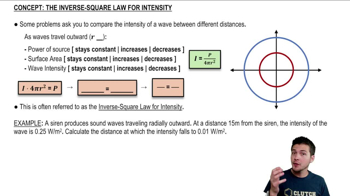
The Inverse-Square Law for Intensity

Image Formation

Image formation involves the interaction of light with optical devices, leading to the creation of images that can be real or virtual. For convex lenses, real images are formed on the opposite side of the lens, while virtual images appear on the same side as the object. Understanding the characteristics of these images, including orientation and size, is essential for answering questions about how the eye perceives images.
Recommended video:
05:51
Refraction at Spherical Surfaces
Related Practice
Textbook Question

As early morning passed toward midday, and the sunlight got more intense, a photographer noted that, if she kept her shutter speed constant, she had to change the f-number from f/5.6 to f/16. By what factor had the sunlight intensity increased during that time?

Textbook Question

A physicist lost in the mountains tries to make a telescope using the lenses from his reading glasses. They have powers of +2.0 D and +4.5 D, respectively.

(a) What maximum magnification telescope is possible?

(b) Which lens should be used as the eyepiece?

1
views
Textbook Question

(II) (a) What is the minimum index of refraction for a glass or plastic prism to be used in binoculars (Fig. 32–34) so that total internal reflection occurs at 45°? (b) Will binoculars work if their prisms (assume n = 1.58) are immersed in water? (c) What minimum n is needed if the prisms are immersed in water?

1
views
Textbook Question

(II) A planoconvex lens (Fig. 33–2a) has one flat surface and the other has R = 15.3 cm. This lens is used to view a red and yellow object which is 62.0 cm away from the lens. The index of refraction of the glass is 1.5106 for red light and 1.5226 for yellow light. What are the locations of the red and yellow images formed by the lens?

2
views
Textbook Question

A 50-year-old man uses +2.5 D lenses to read a newspaper 25 cm away. Ten years later, he must hold the paper 32 cm away to see clearly with the same lenses. What power lenses does he need now in order to hold the paper 25 cm away? (Distances are measured from the lens.)

1
views
Textbook Question

A series of polarizers are each rotated 10° from the previous polarizer. Unpolarized light is incident on this series of polarizers. How many polarizers does the light have to go through before it is 1/6 of its original intensity?

1
views