Ch 33: Wave Optics
Knight Calc - Physics for Scientists and Engineers 5th Edition
Knight Calc5th EditionPhysics for Scientists and EngineersISBN: 9780137344796Not the one you use?Change textbook
Chapter 33, Problem 7

In a double-slit experiment, the slit separation is 200 times the wavelength of the light. What is the angular separation (in degrees) between two adjacent bright fringes?

Verified step by step guidance
1
Identify the formula for angular separation between adjacent bright fringes in a double-slit experiment: \( \Delta \theta = \arcsin\left( \frac{m \lambda}{d} \right) - \arcsin\left( \frac{(m-1) \lambda}{d} \right) \), where \( \lambda \) is the wavelength of light, \( d \) is the slit separation, and \( m \) is the fringe order.
Since the problem asks for the angular separation between two adjacent bright fringes, we can simplify the calculation by using the small-angle approximation: \( \Delta \theta \approx \frac{\lambda}{d} \). This is valid because \( \lambda \ll d \).
Substitute the given relationship between the slit separation and the wavelength: \( d = 200 \lambda \).
Replace \( d \) in the formula with \( 200 \lambda \): \( \Delta \theta \approx \frac{\lambda}{200 \lambda} \).
Simplify the expression to find \( \Delta \theta \) in radians, and then convert it to degrees using the conversion factor \( 1 \text{ radian} = \frac{180}{\pi} \text{ degrees} \).

Verified video answer for a similar problem:

This video solution was recommended by our tutors as helpful for the problem above.
Was this helpful?

Key Concepts

Here are the essential concepts you must grasp in order to answer the question correctly.

Double-Slit Experiment

The double-slit experiment demonstrates the wave nature of light through interference patterns. When coherent light passes through two closely spaced slits, it creates a series of bright and dark fringes on a screen due to constructive and destructive interference. The pattern's characteristics depend on the wavelength of the light and the distance between the slits.
Recommended video:
Guided course
12:00
Young's Double Slit Experiment

Wavelength and Slit Separation

In the context of the double-slit experiment, the slit separation relative to the wavelength of light is crucial for determining the interference pattern. When the slit separation is significantly larger than the wavelength, the angular separation between bright fringes can be calculated using the formula for angular position, which is influenced by the ratio of slit separation to wavelength.
Recommended video:
Guided course
05:42
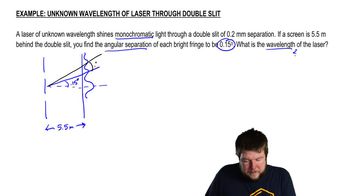
Unknown Wavelength of Laser through Double Slit

Angular Separation of Fringes

The angular separation between adjacent bright fringes in a double-slit experiment can be calculated using the formula θ = λ/d, where θ is the angular separation, λ is the wavelength, and d is the slit separation. This relationship shows how the spacing of the fringes is directly proportional to the wavelength and inversely proportional to the slit separation, allowing for precise predictions of fringe locations.
Recommended video:
Guided course
09:05
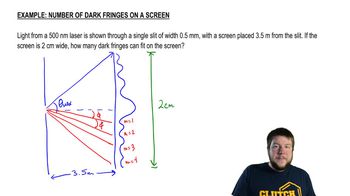
Number of Dark Fringes on a Screen