Ch 03: Vectors and Coordinate Systems
Knight Calc - Physics for Scientists and Engineers 5th Edition
Knight Calc5th EditionPhysics for Scientists and EngineersISBN: 9780137344796Not the one you use?Change textbook
Chapter 3, Problem 28b

The minute hand on a watch is 2.0 cm in length. What is the displacement vector of the tip of the minute hand in each case? Use a coordinate system in which the y-axis points toward the 12 on the watch face. From 8:00 to 9:00 a.m.

Verified step by step guidance
1
Define the problem: The minute hand moves from the 8:00 position to the 9:00 position on the watch face. The displacement vector is the straight-line distance and direction from the initial position of the tip of the minute hand to its final position. The length of the minute hand is 2.0 cm, and the coordinate system is such that the y-axis points toward the 12 on the watch face.
Determine the initial and final positions of the tip of the minute hand in Cartesian coordinates. At 8:00, the minute hand points to the 8 on the watch face, which corresponds to an angle of 240° (measured counterclockwise from the positive y-axis). The coordinates of the tip are given by: \( x_1 = r \sin(\theta_1) \) and \( y_1 = r \cos(\theta_1) \), where \( r = 2.0 \; \text{cm} \) and \( \theta_1 = 240° \).
Similarly, calculate the final position of the tip of the minute hand at 9:00. At 9:00, the minute hand points to the 9 on the watch face, which corresponds to an angle of 270° (measured counterclockwise from the positive y-axis). The coordinates of the tip are given by: \( x_2 = r \sin(\theta_2) \) and \( y_2 = r \cos(\theta_2) \), where \( \theta_2 = 270° \).
Find the displacement vector by subtracting the initial position vector from the final position vector. The displacement vector components are: \( \Delta x = x_2 - x_1 \) and \( \Delta y = y_2 - y_1 \).
Express the displacement vector in vector form: \( \vec{\Delta r} = \Delta x \hat{i} + \Delta y \hat{j} \), where \( \hat{i} \) and \( \hat{j} \) are the unit vectors in the x and y directions, respectively.

Verified video answer for a similar problem:

This video solution was recommended by our tutors as helpful for the problem above.
Was this helpful?

Key Concepts

Here are the essential concepts you must grasp in order to answer the question correctly.

Displacement Vector

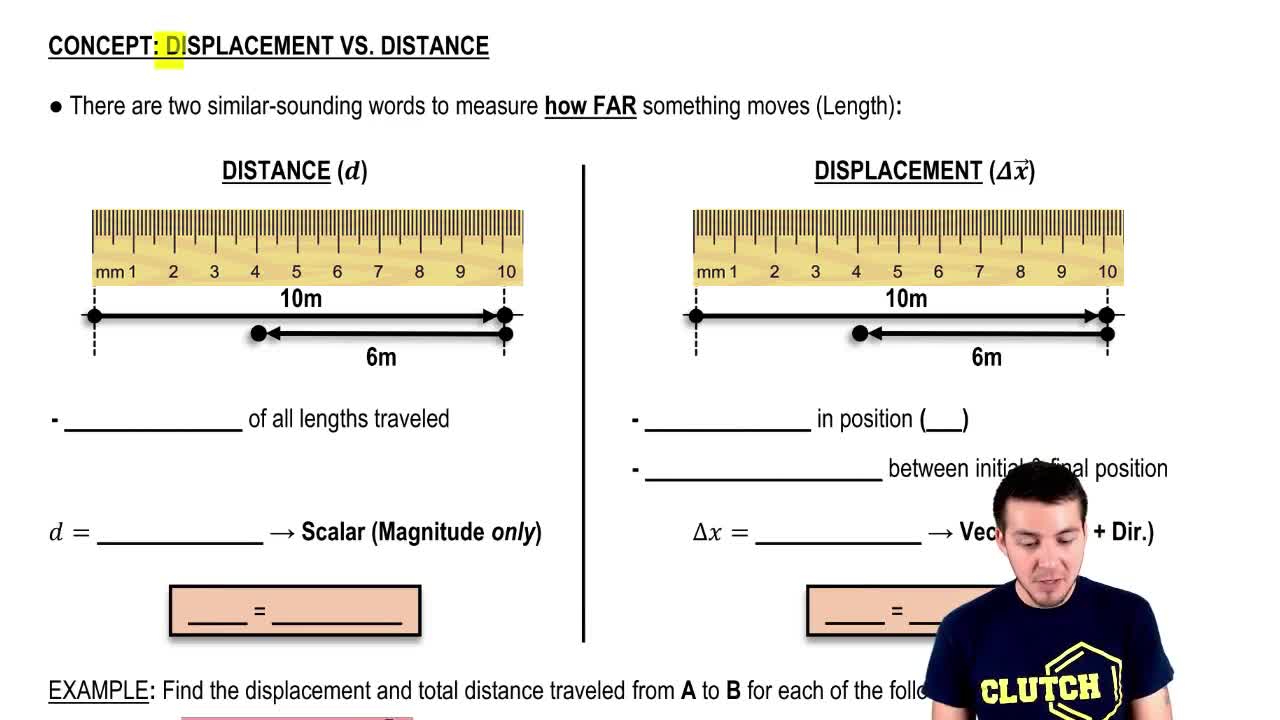
A displacement vector represents the change in position of an object from its initial point to its final point. It is defined by both magnitude and direction. In this context, the displacement vector of the minute hand will indicate how far and in which direction the tip of the hand moves from its position at 8:00 to its position at 9:00.
Recommended video:
Guided course
06:13
Displacement vs. Distance

Circular Motion

The minute hand of a watch moves in a circular path around the center of the watch face. Circular motion is characterized by a constant distance from a central point and involves angular displacement. Understanding the nature of circular motion is essential for calculating the displacement of the minute hand as it moves from one hour mark to another.
Recommended video:
Guided course
03:48
Intro to Circular Motion

Coordinate System

A coordinate system provides a framework for defining the position of points in space. In this problem, a Cartesian coordinate system is used where the y-axis points toward the 12 on the watch face. This system allows for the precise calculation of the displacement vector by translating the circular motion of the minute hand into x and y coordinates.
Recommended video:
Guided course
05:17
Coordinates of Center of Mass of 4 objects
Related Practice
Textbook Question

Find a vector that points in the same direction as the vector ( î + ĵ ) and whose magnitude is 1.

2
views

Textbook Question

While vacationing in the mountains you do some hiking. In the morning, your displacement is Smorning=(2000m,east)+(3000m,north)+(200m,vertical)\(\mathbf{S}\)_{morning} = (2000 \, \(\text{m}\), \(\text{east}\)) + (3000 \, \(\text{m}\), \(\text{north}\)) + (200 \, \(\text{m}\), \(\text{vertical}\)). Continuing on after lunch, your displacement is Safternoon=(1500m,west)+(2000m,north)(300m,vertical)\(\mathbf{S}\)_{afternoon} = (1500 \, \(\text{m}\), \(\text{west}\)) + (2000 \, \(\text{m}\), \(\text{north}\)) - (300 \, \(\text{m}\), \(\text{vertical}\)). What is the magnitude of your net displacement for the day?

3
views
Textbook Question

Trevon drives with velocity v1 = (55î - 10ĵ) mph for 1.0 h, then v2 = (20î + 50ĵ) mph for 2.0 h. What is Trevon's displacement? Write your answer in component form using unit vectors.

Textbook Question

The minute hand on a watch is 2.0 cm in length. What is the displacement vector of the tip of the minute hand in each case? Use a coordinate system in which the y-axis points toward the 12 on the watch face. From 8:00 to 8:20 a.m.

1
views
Textbook Question

While vacationing in the mountains you do some hiking. In the morning, your displacement is Smorning=(2000m,east)+(3000m,north)+(200m,vertical)\(\mathbf{S}\)_{morning} = (2000 \, \(\text{m}\), \(\text{east}\)) + (3000 \, \(\text{m}\), \(\text{north}\)) + (200 \, \(\text{m}\), \(\text{vertical}\)). Continuing on after lunch, your displacement is Safternoon=(1500m,west)+(2000m,north)(300m,vertical)\(\mathbf{S}\)_{afternoon} = (1500 \, \(\text{m}\), \(\text{west}\)) + (2000 \, \(\text{m}\), \(\text{north}\)) - (300 \, \(\text{m}\), \(\text{vertical}\)). At the end of the hike, how much higher or lower are you compared to your starting point?

2
views
Textbook Question

FIGURE P3.26 shows vectors A and B. Find D = 2A +B Write your answer in component form.

1
views