Ch. 28 - Sources of Magnetic Field
Giancoli Douglas - Physics for Scientists and Engineers 5th edition
Giancoli Douglas5th editionPhysics for Scientists and EngineersISBN: 9780137488179Not the one you use?Change textbook
Chapter 27, Problem 57

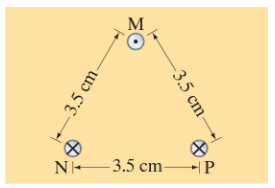
In Fig. 28–57 the top wire is 1.00-mm-diameter copper wire and is suspended in air due to the two magnetic forces from the bottom two wires. The current is 35.0 A in each of the two bottom wires. Calculate the required current in the suspended wire (M).

Verified step by step guidance
1
Identify the forces acting on the suspended wire. The wire is in equilibrium, so the upward magnetic forces from the two bottom wires must balance the downward gravitational force acting on the suspended wire.
Calculate the gravitational force acting on the suspended wire. Use the formula for weight: \( F_g = m g \), where \( m \) is the mass of the wire and \( g \) is the acceleration due to gravity. To find \( m \), use the density of copper \( \rho \) and the volume of the wire: \( m = \rho V \), where \( V = \pi r^2 L \) (\( r \) is the radius of the wire and \( L \) is its length).
Determine the magnetic force on the suspended wire due to one of the bottom wires. Use the formula for the magnetic force between two parallel current-carrying wires: \( F_B = \frac{\mu_0 I_1 I_2}{2 \pi d} L \), where \( \mu_0 \) is the permeability of free space, \( I_1 \) and \( I_2 \) are the currents in the wires, \( d \) is the distance between the wires, and \( L \) is the length of the wire.
Account for the contributions of both bottom wires. Since the two bottom wires are symmetrically placed, their magnetic forces will add up. The total upward magnetic force is \( F_{B,\text{total}} = 2 F_B \). Set this equal to the gravitational force \( F_g \) to satisfy the equilibrium condition: \( F_{B,\text{total}} = F_g \).
Solve for the required current \( M \) in the suspended wire. Rearrange the equilibrium equation to isolate \( M \) (the current in the suspended wire). Substitute all known values, including the current in the bottom wires, the distance between the wires, and the physical properties of the copper wire, to find \( M \).

Verified video answer for a similar problem:

This video solution was recommended by our tutors as helpful for the problem above.
Video duration:
11m
Was this helpful?

Key Concepts

Here are the essential concepts you must grasp in order to answer the question correctly.

Magnetic Force on a Current-Carrying Wire

When a current flows through a wire in a magnetic field, it experiences a magnetic force. This force is given by the equation F = I * L * B * sin(θ), where F is the force, I is the current, L is the length of the wire, B is the magnetic field strength, and θ is the angle between the wire and the magnetic field. In this scenario, the magnetic forces from the bottom wires must balance the weight of the suspended wire.
Recommended video:
Guided course
09:57
Magnetic Force on Current-Carrying Wire

Ampere's Law

Ampere's Law relates the integrated magnetic field around a closed loop to the electric current passing through the loop. It is essential for calculating the magnetic field generated by the currents in the bottom wires, which affects the suspended wire. The law can be expressed as ∮B·dl = μ₀I, where B is the magnetic field, dl is a differential length element of the loop, μ₀ is the permeability of free space, and I is the current.
Recommended video:
Guided course
05:21
Ampere's Law with Calculus

Equilibrium of Forces

In this problem, the suspended wire is in equilibrium, meaning the net force acting on it is zero. This requires that the upward magnetic forces from the two bottom wires equal the downward gravitational force acting on the suspended wire. Understanding this balance is crucial for determining the required current in the suspended wire to maintain its position.
Recommended video:
Related Practice
Textbook Question

(III) Use the result of Problem 44 to find the magnetic field at point P in Fig. 28–53 due to the current in the square loop.


1
views

Textbook Question

Helmholtz coils are two identical circular coils having the same radius 𝑅 and the same number of turns N, separated by a distance equal to the radius 𝑅 and carrying the same dc current I in the same direction. (See Fig. 28–61.) They are used in scientific instruments to generate nearly uniform magnetic fields. (They can be seen in the photo, Fig. 27–19.) (a) Determine the magnetic field B at points 𝓍 along the line joining their centers. Let 𝓍 = 0 at the center of one coil, and 𝓍 = 𝑅 at the center of the other. (b) Show that the field midway between the coils is particularly uniform by showing that dB/d𝓍 = 0 and d²B/d𝓍² = 0 at the midpoint between the coils. (c) If 𝑅 = 10.0 cm, N = 85 turns and I = 3.0 A, what is the field at the midpoint between the coils, 𝓍 = 𝑅/2?

2
views
Textbook Question

A long horizontal wire carries a current of 42 A. A second wire, made of 1.00-mm-diameter copper wire and parallel to the first, is kept in suspension magnetically 5.0 cm below (Fig. 28–60). (a) Determine the magnitude and direction of the current in the lower wire. (b) Is the lower wire in stable equilibrium? (c) Repeat parts (a) and (b) if the second wire is suspended 5.0 cm above the first due to the first’s magnetic field.

1
views
Textbook Question

Three long parallel wires are 3.5 cm from one another. (Looking along them, they are at three corners of an equilateral triangle.) The current in each wire is 9.50 A, but its direction in wire M is opposite to that in wires N and P (Fig. 28–57). Determine the magnetic force per unit length on each wire due to the other two.


1
views
Textbook Question

(III) A square loop of wire, of side d, carries a current I. (a) Determine the magnetic field B at points on a line (call it the 𝓍 axis) perpendicular to the plane of the square which passes through the center of the square (Fig. 28–56). Express B as a function of 𝓍, the distance from the center of the square. (b) For 𝓍 ≫ d, does the square appear to be a magnetic dipole? If so, what is its dipole moment?


1
views
Textbook Question

A set of Helmholtz coils (see Problem 62, Fig. 28–61) have a radius 𝑅 = 10.0 cm and are separated by a distance 𝑅 = 10.0 cm . Each coil has 85 loops carrying a current I = 2.0 A. Graph B as a function of 𝓍.

1
views