
Ch 19: Work, Heat, and the First Law of Thermodynamics
Knight Calc - Physics for Scientists and Engineers 5th Edition
Knight Calc5th EditionPhysics for Scientists and EngineersISBN: 9780137344796Not the one you use?Change textbook
Chapter 19, Problem 78

10 g of aluminum at 200°C and 20 g of copper are dropped into 50 cm3 of ethyl alcohol at 15°C. The temperature quickly comes to 25°C. What was the initial temperature of the copper?

Verified step by step guidance
1
Identify the principle of conservation of energy: The heat lost by the aluminum and copper will equal the heat gained by the ethyl alcohol, assuming no heat is lost to the surroundings.
Write the heat transfer equation for each material: For aluminum and copper, the heat lost is given by \( Q = m c \Delta T \), and for ethyl alcohol, the heat gained is also \( Q = m c \Delta T \).
Express the heat transfer for each material: For aluminum, \( Q_{Al} = m_{Al} c_{Al} (T_{Al,initial} - T_{final}) \); for copper, \( Q_{Cu} = m_{Cu} c_{Cu} (T_{Cu,initial} - T_{final}) \); and for ethyl alcohol, \( Q_{EA} = m_{EA} c_{EA} (T_{final} - T_{EA,initial}) \).
Set up the energy conservation equation: \( Q_{Al} + Q_{Cu} = Q_{EA} \). Substitute the expressions for \( Q \) from the previous step into this equation.
Solve for the initial temperature of copper \( T_{Cu,initial} \): Rearrange the equation to isolate \( T_{Cu,initial} \), substituting the known values for masses, specific heats, and temperatures. Be sure to convert the volume of ethyl alcohol to mass using its density.

Verified video answer for a similar problem:

This video solution was recommended by our tutors as helpful for the problem above.
Video duration:
8m
Was this helpful?

Key Concepts

Here are the essential concepts you must grasp in order to answer the question correctly.

Heat Transfer

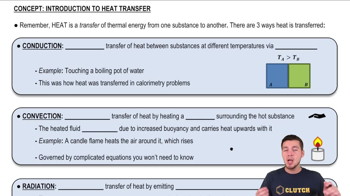
Heat transfer is the process of thermal energy moving from one object to another due to a temperature difference. In this scenario, heat flows from the aluminum and copper to the ethyl alcohol until thermal equilibrium is reached. Understanding how heat is exchanged is crucial for solving problems involving temperature changes in different materials.
Recommended video:
Guided course
05:14
Overview of Heat Transfer

Specific Heat Capacity

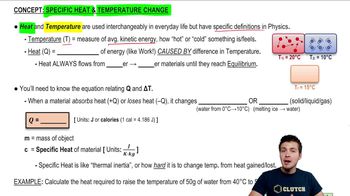
Specific heat capacity is the amount of heat required to raise the temperature of a unit mass of a substance by one degree Celsius. Each material has a unique specific heat capacity, which affects how much its temperature changes when heat is added or removed. This concept is essential for calculating the final temperatures of the aluminum, copper, and ethyl alcohol in the given problem.
Recommended video:
Guided course
06:50
Specific Heat & Temperature Changes

Thermal Equilibrium

Thermal equilibrium occurs when two or more bodies in thermal contact reach the same temperature, resulting in no net heat flow between them. In this problem, the aluminum, copper, and ethyl alcohol reach a common temperature of 25°C. Understanding thermal equilibrium helps in applying the principle of conservation of energy to find unknown initial temperatures.
Recommended video:
Guided course
05:21
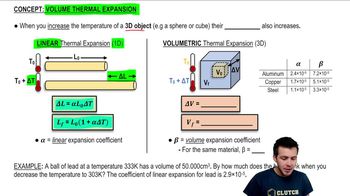
Volume Thermal Expansion
Related Practice
Textbook Question

One cylinder in the diesel engine of a truck has an initial volume of 600 cm3. Air is admitted to the cylinder at 30°C and a pressure of 1.0 atm. The piston rod then does 400 J of work to rapidly compress the air. What are its final temperature and volume?

1
views
Textbook Question

FIGURE CP19.80 shows a thermodynamic process followed by 0.015 mol of hydrogen. How much heat energy is transferred to the gas?

2
views
Textbook Question

In Problems 75, 76, and 77 you are given the equation used to solve a problem. For each of these, you are to write a realistic problem for which this is the correct equation.

50J=n(8.31J/mol K)(350K)ln(13)(200×106m3)(13,600kg/m3)50\,\(\text{J}\)=-n(8.31\,\(\text{J/mol K}\))(350\,\(\text{K}\))\(\ln\]\left\)(\(\frac\)13\(\right\))(200\(\times\)10^{-6}\,\(\text{m}\)^3)(13,600\,\(\text{kg/m}\)^3)

1
views
Textbook Question

A lava flow is threatening to engulf a small town. A 400-m-wide, 35-cm-thick tongue of 1200°C lava is advancing at the rate of 1.0 m per minute. The mayor devises a plan to stop the lava in its tracks by flying in large quantities of 20°C water and dousing it. The lava has density 2500 kg/m3, specific heat 1100 J/kg K, melting temperature 800°C, and heat of fusion 4.0×10⁵ J/kg. How many liters of water per minute, at a minimum, will be needed to save the town?

2
views
Textbook Question

A flow-through electric water heater has a 20 kW electric heater inside an insulated 2.0-cm-diameter pipe so that water flowing through the pipe will have good thermal contact with the heater. Assume that all the heat energy is transferred to the water. Suppose the inlet water temperature is 12°C and the flow rate is 8.0 L/min (about that of a standard shower head). What is the outlet temperature?

1
views