Ch 31: Electromagnetic Fields and Waves
Knight Calc - Physics for Scientists and Engineers 5th Edition
Knight Calc5th EditionPhysics for Scientists and EngineersISBN: 9780137344796Not the one you use?Change textbook
Chapter 31, Problem 40

A 1.0 μF capacitor is discharged, starting at t = 0 s.The displacement current between the plates is Idisp=(10 A)exp(t2.0 μs)I_{\(\text{disp}\)}=(10\(\text{ A}\))\(\exp\]\left\)(-\(\frac{t}{2.0\text{ }\)}\(\mu\[\text{s}\]\right\)). What was the capacitor’s initial voltage (ΔVC)₀?

Verified step by step guidance
1
Step 1: Understand the relationship between displacement current and the rate of change of electric field in a capacitor. The displacement current is given by the formula: Idisp=CdVdt, where C is the capacitance and V is the voltage across the capacitor.
Step 2: Substitute the given displacement current expression Idisp=10Aexp(-t/2.0μs) into the formula for displacement current. This gives: 10exp(-t/2.0μs)=1.0μFdVdt.
Step 3: Rearrange the equation to isolate dVdt. This gives: dVdt=10exp(-t/2.0μs)1.0μF.
Step 4: Integrate both sides with respect to time to find the voltage V. The integral of the displacement current expression is: 10exp(-t/2.0μs)dt. Evaluate this integral to find the voltage as a function of time.
Step 5: Determine the initial voltage (ΔVC)0 by evaluating the voltage expression at t=0. This involves substituting t=0 into the integrated voltage equation.

Verified video answer for a similar problem:

This video solution was recommended by our tutors as helpful for the problem above.
Was this helpful?

Key Concepts

Here are the essential concepts you must grasp in order to answer the question correctly.

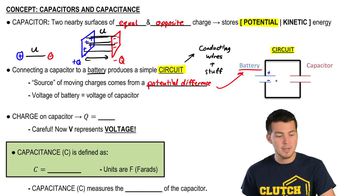
Capacitance

Capacitance is the ability of a capacitor to store charge per unit voltage. It is defined as C = Q/V, where C is capacitance in farads, Q is the charge in coulombs, and V is the voltage across the capacitor. In this case, the capacitor has a capacitance of 1.0 μF, which indicates how much charge it can hold at a given voltage.
Recommended video:
Guided course
08:02
Capacitors & Capacitance (Intro)

Displacement Current

Displacement current is a concept introduced by James Clerk Maxwell to account for changing electric fields in capacitors. It is defined as Iₑₓₜ = ε₀(dΦ_E/dt), where ε₀ is the permittivity of free space and dΦ_E/dt is the rate of change of the electric field. In this problem, the displacement current is given as a function of time, indicating how the current changes as the capacitor discharges.
Recommended video:
Guided course
06:13
Displacement vs. Distance

Exponential Decay

Exponential decay describes the process by which a quantity decreases at a rate proportional to its current value. In the context of the displacement current, the equation Iₔᵢₛₚ = (10 A)exp(−t/2.0 μs) shows that the current decreases exponentially over time, which is characteristic of discharging capacitors. This behavior is crucial for determining the initial voltage across the capacitor.
Recommended video:
Guided course
04:24
Amplitude Decay in an LRC Circuit
Related Practice
Textbook Question

At one instant, the electric and magnetic fields at one point of an electromagnetic wave are E=(200i^+300j^50k^) V/m\(\mathbf{E}\) = (200 \(\hat{\mathbf{i}\)} + 300 \(\hat{\mathbf{j}\)} - 50 \(\hat{\mathbf{k}\)}) \(\text{ V/m}\) and B=B0(7.3i^7.3j^+ak^ μT\(\mathbf{B}\)=B_0(7.3\(\hat{\mathbf{i}\)}-7.3\(\hat{\mathbf{j}\)}+a\(\hat{\mathbf{k}\)}\(\text{ }\]\mu\) T. What is the Poynting vector at this time and position?

1
views

Textbook Question

A wire with conductivity σ carries current I. The current is increasing at the rate dI/dt. Evaluate the displacement current for a copper wire in which the current is increasing at 1.0×10⁶ A/s.

1
views
Textbook Question

What is the total energy density in an electromagnetic wave of intensity 1000 W/m2?

Textbook Question

A 10 A current is charging a 1.0-cm-diameter parallel-plate capacitor. What is the magnetic field strength at a point 2.0 mm radially from the center of the capacitor?

1
views
Textbook Question

At one instant, the electric and magnetic fields at one point of an electromagnetic wave are E=(200i^+300j^50k^) V/m\(\overrightarrow{E}\)=(200\(\hat{i}\)+300\(\hat{j}\)-50\(\hat{k}\))\(\text{ V/m}\) and B=B0(7.3i^7.3j^+ak^) μT\(\overrightarrow{B}\)=B_0(7.3\(\hat{i}\)-7.3\(\hat{j}\)+a\(\hat{k}\))\(\text{ }\[\mu\]\text{T}\). What are the values of aa and B0B_0?

1
views
Textbook Question

FIGURE P31.38 shows the electric field inside a cylinder of radius R=3.0R=3.0 mm. The field strength is increasing with time as E=1.0×10⁸t2E=1.0\(\times\)10^8t^{2} V/m, where t is in s. The electric field outside the cylinder is always zero, and the field inside the cylinder was zero for t<0t<0. Find an expression for the electric flux ΦeΦ_e through the entire cylinder as a function of time.

1
views