Ch 30: Electromagnetic Induction
Knight Calc - Physics for Scientists and Engineers 5th Edition
Knight Calc5th EditionPhysics for Scientists and EngineersISBN: 9780137344796Not the one you use?Change textbook
Chapter 30, Problem 3

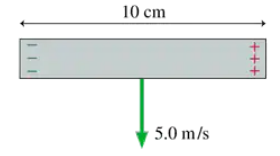
A potential difference of 0.050 V is developed across the 10-cm-long wire of FIGURE EX30.3 as it moves through a magnetic field perpendicular to the figure. What are the strength and direction (in or out) of the magnetic field?

Verified step by step guidance
1
Step 1: Identify the relevant formula for the electromotive force (EMF) induced in a moving conductor within a magnetic field. The formula is \( \text{EMF} = B \cdot v \cdot L \), where \( B \) is the magnetic field strength, \( v \) is the velocity of the wire, and \( L \) is the length of the wire.
Step 2: Rearrange the formula to solve for the magnetic field strength \( B \). This gives \( B = \frac{\text{EMF}}{v \cdot L} \).
Step 3: Substitute the given values into the formula. The potential difference (EMF) is \( 0.050 \, \text{V} \), the length of the wire \( L \) is \( 10 \, \text{cm} \) (convert to meters: \( 0.10 \, \text{m} \)), and the velocity \( v \) of the wire is provided or needs to be determined from the context of the problem.
Step 4: Determine the direction of the magnetic field using the right-hand rule. The rule states that if the wire moves through the magnetic field, the direction of the induced EMF depends on the orientation of the wire's motion relative to the field. Analyze the figure to decide whether the field points into or out of the page.
Step 5: Once the values are substituted and the direction is determined, you will have the magnetic field strength \( B \) and its direction (into or out of the page).

Verified video answer for a similar problem:

This video solution was recommended by our tutors as helpful for the problem above.
Video duration:
3m
Was this helpful?

Key Concepts

Here are the essential concepts you must grasp in order to answer the question correctly.

Electromagnetic Induction

Electromagnetic induction is the process by which a changing magnetic field can induce an electromotive force (EMF) in a conductor. This principle is fundamental in understanding how a potential difference is generated when a wire moves through a magnetic field. The induced EMF is directly proportional to the rate of change of the magnetic flux through the wire.
Recommended video:
Guided course
05:42
Introduction to Induction

Lorentz Force

The Lorentz force is the force experienced by a charged particle moving through a magnetic field. It is given by the equation F = q(v × B), where F is the force, q is the charge, v is the velocity of the particle, and B is the magnetic field. This concept is crucial for determining the direction of the magnetic field based on the motion of the wire and the induced potential difference.
Recommended video:
Guided course
13:39
Lorentz Transformations of Velocity

Right-Hand Rule

The Right-Hand Rule is a mnemonic used to determine the direction of the magnetic force, magnetic field, and current in electromagnetic systems. By aligning the thumb of the right hand with the direction of the current and the fingers with the magnetic field, the palm points in the direction of the force. This rule helps visualize the relationship between the wire's motion, the magnetic field, and the resulting induced EMF.
Recommended video:
Guided course
19:11
Force on Moving Charges & Right Hand Rule