
Ch. 08 - Conservation of Energy
Giancoli Douglas - Physics for Scientists and Engineers 5th edition
Giancoli Douglas5th editionPhysics for Scientists and EngineersISBN: 9780137488179Not the one you use?Change textbook
Chapter 8, Problem 26b

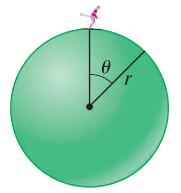
A skier of mass m starts from rest at the top of a solid sphere of radius r and slides down its frictionless surface. If friction is present, does the skier fly off at a greater or lesser angle?
A skier on top of a solid sphere, with angle θ and radius r marked, illustrating motion dynamics.

Verified step by step guidance
1
The skier starts from rest at the top of the sphere, so their initial potential energy is given by \( U = m g h \), where \( h \) is the height of the skier above the ground. At any point during the motion, the skier's total energy is conserved (if friction is absent). This means \( m g h = \frac{1}{2} m v^2 + m g h' \), where \( h' \) is the new height and \( v \) is the skier's velocity.
The skier will lose contact with the sphere when the normal force becomes zero. At this point, the only force acting on the skier in the radial direction is the component of gravity, which provides the centripetal force. Using Newton's second law in the radial direction, we write \( m g \cos(\theta) = \frac{m v^2}{r} \), where \( \theta \) is the angle the skier makes with the vertical.
To find the angle \( \theta \) at which the skier loses contact, we combine the energy conservation equation and the centripetal force condition. From energy conservation, \( v^2 = 2 g (h - h') \). Substituting \( h = r \) and \( h' = r \cos(\theta) \), we get \( v^2 = 2 g r (1 - \cos(\theta)) \).
Substitute \( v^2 \) from the energy equation into the centripetal force equation: \( m g \cos(\theta) = \frac{m [2 g r (1 - \cos(\theta))]}{r} \). Simplify this equation to solve for \( \cos(\theta) \), which gives the angle at which the skier loses contact.
If friction is present, it will reduce the skier's speed because some of the mechanical energy is dissipated as heat. A lower speed means a smaller centripetal force, so the skier will lose contact at a lesser angle (closer to the top of the sphere).

Verified video answer for a similar problem:

This video solution was recommended by our tutors as helpful for the problem above.
Video duration:
9m
Was this helpful?

Key Concepts

Here are the essential concepts you must grasp in order to answer the question correctly.

Newton's Laws of Motion

Newton's Laws of Motion describe the relationship between the motion of an object and the forces acting on it. The first law states that an object at rest stays at rest unless acted upon by a net force. The second law quantifies this relationship with F=ma, indicating that the acceleration of an object is directly proportional to the net force and inversely proportional to its mass. The third law states that for every action, there is an equal and opposite reaction, which is crucial for understanding the forces acting on the skier.
Recommended video:
Guided course
04:46
Newton's 1st Law

Centripetal Force

Centripetal force is the net force required to keep an object moving in a circular path and is directed towards the center of the circle. In the context of the skier sliding down the sphere, this force is provided by the gravitational component acting towards the center of the sphere. If friction is present, it alters the net force acting on the skier, potentially affecting the angle at which the skier leaves the surface of the sphere.
Recommended video:
Guided course
06:48
Intro to Centripetal Forces

Energy Conservation

The principle of energy conservation states that energy cannot be created or destroyed, only transformed from one form to another. In this scenario, the skier converts gravitational potential energy at the top of the sphere into kinetic energy as they slide down. If friction is introduced, some energy is dissipated as thermal energy, which can affect the skier's speed and the angle at which they leave the surface, leading to a different trajectory compared to a frictionless scenario.
Recommended video:
Guided course
06:24
Conservation Of Mechanical Energy
Related Practice
Textbook Question

Consider the track shown in Fig. 8–39. The section AB is one quadrant of a circle of radius 2.0 m and is frictionless. B to C is a horizontal span 3.0 m long with a coefficient of kinetic friction μₖ = 0.25. The section CD under the spring is frictionless. A block of mass 1.0 kg is released from rest at A. After sliding on the track, it compresses the spring by 0.20 m. Determine the velocity of the block at point B.

Textbook Question

Two masses are connected by a string as shown in Fig. 8–35. Mass mA = 3.5 kg rests on a frictionless inclined plane, while mB = 5.0 kg is initially held at a height of h = 0.75 m above the floor. Use conservation of energy to find the velocity of the masses just before mB hits the floor. You should get the same answer as in part (b).

2
views
Textbook Question

Chris jumps off a bridge with a 15-m-long bungee cord (a heavy stretchable cord) tied around his ankle, Fig. 8–37. He falls 15 m before the bungee cord begins to stretch. Chris’s mass is 75 kg and we assume the cord obeys Hooke’s law, F = -kx with k = 55 N/m. If we neglect air resistance, estimate what distance d below the bridge Chris’s foot will be before coming to a stop. Ignore the mass of the cord (not realistic, however) and treat Chris as a particle.

1
views
Textbook Question

The 9.0-kg mass in Fig. 8–36 is held just barely in contact with a spring for which k = 450 N/m . When that mass is released, it falls, compressing the spring and pulling the 3.0-kg mass up. How far does the 9.0-kg mass fall before momentarily coming to rest? Ignore friction in the pulley.

Textbook Question

Consider the track shown in Fig. 8–39. The section AB is one quadrant of a circle of radius 2.0 m and is frictionless. B to C is a horizontal span 3.0 m long with a coefficient of kinetic friction μₖ = 0.25. The section CD under the spring is frictionless. A block of mass 1.0 kg is released from rest at A. After sliding on the track, it compresses the spring by 0.20 m. Determine the thermal energy produced as the block slides from B to C.

Textbook Question

You slide down an 8.0-m-high icy hill (≈ frictionless). At the bottom is a level stretch where the coefficient of kinetic friction is 0.30. How far would you travel across the level stretch?

2
views