Ch. 24 - Capacitance, Dielectrics, Electric Energy, Storage
Giancoli Douglas - Physics for Scientists and Engineers 5th edition
Giancoli Douglas5th editionPhysics for Scientists and EngineersISBN: 9780137488179Not the one you use?Change textbook
Chapter 23, Problem 70

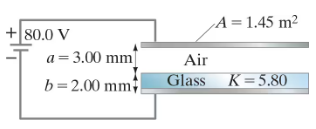
The capacitor shown in Fig. 24–34 is connected to an 80.0-V battery. Calculate (and sketch) the electric field everywhere between the capacitor plates. Find both the free charge on each capacitor plate and the induced charge on the faces of the glass dielectric plate.
Diagram of a capacitor connected to an 80.0-V battery, showing dimensions and materials involved in the electric field calculation.

Verified step by step guidance
1
Step 1: Understand the setup of the capacitor. The capacitor consists of two parallel plates separated by two layers: air (thickness a = 3.00 mm) and glass (thickness b = 2.00 mm, dielectric constant K = 5.80). The area of the plates is A = 1.45 m², and the capacitor is connected to a battery providing a voltage of 80.0 V.
Step 2: Calculate the electric field in each region (air and glass). The electric field in a dielectric is given by \( E = \frac{V}{d} \), where \( d \) is the thickness of the region. For the air region, \( E_{\text{air}} = \frac{V_{\text{air}}}{a} \), and for the glass region, \( E_{\text{glass}} = \frac{V_{\text{glass}}}{b} \). The voltage across each region can be determined using the relationship \( V = E \cdot d \) and the fact that the total voltage across the capacitor is 80.0 V.
Step 3: Determine the free charge on the capacitor plates. The free charge \( Q \) is related to the capacitance \( C \) and the voltage \( V \) by \( Q = C \cdot V \). The capacitance of the capacitor can be calculated using the formula for capacitors with multiple dielectrics: \( C = \frac{\varepsilon_0 A}{\frac{a}{K_{\text{air}}} + \frac{b}{K_{\text{glass}}}} \), where \( \varepsilon_0 \) is the permittivity of free space, \( K_{\text{air}} = 1 \), and \( K_{\text{glass}} = 5.80 \).
Step 4: Calculate the induced charge on the faces of the glass dielectric. The induced charge \( Q_{\text{induced}} \) is related to the polarization of the dielectric material. The polarization \( P \) is given by \( P = \varepsilon_0 (K - 1) E \), where \( E \) is the electric field in the glass region. The induced charge is then \( Q_{\text{induced}} = P \cdot A \).
Step 5: Sketch the electric field distribution. The electric field is uniform within each region (air and glass) but has different magnitudes due to the differing dielectric properties. The field in the air region is stronger than in the glass region because the dielectric constant of air is lower. Label the regions and indicate the direction of the electric field, which points from the positive plate to the negative plate.

Key Concepts

Here are the essential concepts you must grasp in order to answer the question correctly.

Electric Field in a Capacitor

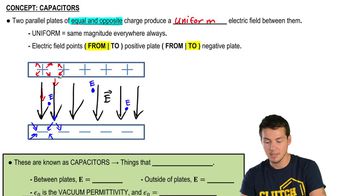
The electric field (E) between the plates of a capacitor is defined as the voltage (V) across the plates divided by the distance (d) between them. For a parallel plate capacitor, E = V/d. In this case, the voltage is 80.0 V, and the distance is the combined thickness of the air and glass dielectric layers, which affects the overall electric field strength.
Recommended video:
Guided course
06:13
Intro to Capacitors

Capacitance and Charge

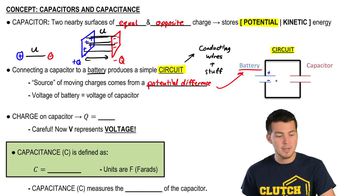
Capacitance (C) is the ability of a capacitor to store charge per unit voltage, given by the formula C = εA/d, where ε is the permittivity of the dielectric material, A is the area of the plates, and d is the separation between them. The free charge (Q) on the plates can be calculated using Q = CV, where V is the voltage applied. The presence of a dielectric material modifies the capacitance and the charge distribution.
Recommended video:
Guided course
08:02
Capacitors & Capacitance (Intro)

Dielectric Materials

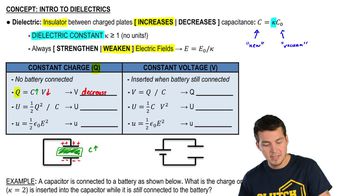
Dielectric materials, such as glass in this scenario, are insulators that can be polarized by an electric field, which reduces the effective electric field within the capacitor. The dielectric constant (K) quantifies this effect, with K = 5.80 for glass. This constant is used to calculate the modified capacitance and the induced charge on the dielectric's surfaces, which is essential for understanding the charge distribution in the capacitor.
Recommended video:
Guided course
06:25
Intro To Dielectrics
Related Practice