Ch 20: The Second Law of Thermodynamics
Young & Freedman Calc - University Physics 14th Edition
Young & Freedman Calc14th EditionUniversity PhysicsISBN: 9780321973610Not the one you use?Change textbook
Chapter 20, Problem 12b

A Carnot engine is operated between two heat reservoirs at temperatures of 520520 K and 300300 K. How much mechanical work is performed by the engine during each cycle?

Verified step by step guidance
1
Understand the concept of a Carnot engine: A Carnot engine is an idealized heat engine that operates on the reversible Carnot cycle. It is the most efficient engine possible between two heat reservoirs.
Identify the given temperatures: The high-temperature reservoir (T1) is at 520 K, and the low-temperature reservoir (T2) is at 300 K.
Calculate the efficiency of the Carnot engine using the formula: \( \eta = 1 - \frac{T2}{T1} \). Substitute the given temperatures into this formula to find the efficiency.
Relate the efficiency to work and heat: The efficiency \( \eta \) is also defined as the ratio of the work done by the engine (W) to the heat absorbed from the high-temperature reservoir (Q1), i.e., \( \eta = \frac{W}{Q1} \).
To find the mechanical work performed (W), rearrange the efficiency formula to \( W = \eta \times Q1 \). You will need the value of Q1, the heat absorbed from the high-temperature reservoir, to calculate W.

Verified video answer for a similar problem:

This video solution was recommended by our tutors as helpful for the problem above.
Video duration:
4m
Was this helpful?

Key Concepts

Here are the essential concepts you must grasp in order to answer the question correctly.

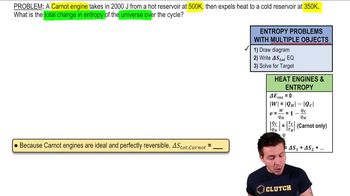
Carnot Engine

A Carnot engine is a theoretical thermodynamic cycle that operates between two heat reservoirs, achieving maximum efficiency. It is an idealized model that assumes no energy losses due to friction or other inefficiencies, and its efficiency depends solely on the temperatures of the heat reservoirs.
Recommended video:
Guided course
03:56
Entropy of Carnot Engine

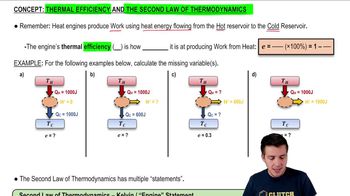
Thermodynamic Efficiency

Thermodynamic efficiency of a heat engine is defined as the ratio of work output to heat input. For a Carnot engine, this efficiency is determined by the temperatures of the hot and cold reservoirs, calculated using the formula: Efficiency = 1 - (T_cold/T_hot), where temperatures are in Kelvin.
Recommended video:
Guided course
06:01
Thermal Efficiency & The Second Law of Thermodynamics

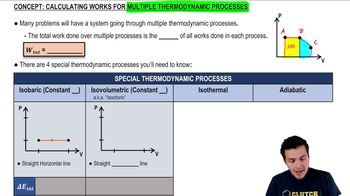
Mechanical Work in Thermodynamics

Mechanical work in thermodynamics refers to the energy transferred by the system to its surroundings during a cycle. In the context of a Carnot engine, the work done is the useful energy output, calculated by multiplying the efficiency by the heat absorbed from the hot reservoir during each cycle.
Recommended video:
Guided course
07:44
Calculating Works For Multiple Thermodynamic Processes
Related Practice
Textbook Question

A certain brand of freezer is advertised to use 730730 kWh of energy per year. What is the theoretical maximum amount of ice this freezer could make in an hour, starting with water at 20.020.0°C?

1
views
Textbook Question

The coefficient of performance K=H/PK = H/P is a dimensionless quantity. Its value is independent of the units used for HH and PP, as long as the same units, such as watts, are used for both quantities. However, it is common practice to express HH in Btu/h and PP in watts. When these mixed units are used, the ratio H/PH/P is called the energy efficiency ratio (EEREER). If a room air conditioner has K=3.0K = 3.0, what is its EEREER?

1
views
Textbook Question

A Carnot engine is operated between two heat reservoirs at temperatures of 520520 K and 300300 K. What is the thermal efficiency of the engine?

1
views
Textbook Question

A Carnot engine is operated between two heat reservoirs at temperatures of 520520 K and 300300 K. If the engine receives 6.456.45 kJ of heat energy from the reservoir at 520520 K in each cycle, how many joules per cycle does it discard to the reservoir at 300300 K?

2
views
Textbook Question

A certain brand of freezer is advertised to use 730730 kWh of energy per year. Assuming the freezer operates for 55 hours each day, how much power does it require while operating?

2
views
Textbook Question

A refrigerator has a coefficient of performance of 2.252.25, runs on an input of 135135 W of electrical power, and keeps its inside compartment at 55°C. If you put a dozen 1.01.0-L plastic bottles of water at 3131°C into this refrigerator, how long will it take for them to be cooled down to 5 5°C? (Ignore any heat that leaves the plastic.)

2
views