Ch 02: Motion Along a Straight Line
Young & Freedman Calc - University Physics 14th Edition
Young & Freedman Calc14th EditionUniversity PhysicsISBN: 9780321973610Not the one you use?Change textbook
Chapter 2, Problem 28a

A car sits on an entrance ramp to a freeway, waiting for a break in the traffic. Then the driver accelerates with constant acceleration along the ramp and onto the freeway. The car starts from rest, moves in a straight line, and has a speed of 2020 m/s (4545 mi/h) when it reaches the end of the 120120-m-long ramp. What is the acceleration of the car?

Verified step by step guidance
1
Identify the known values: initial velocity (v₀) = 0 m/s (since the car starts from rest), final velocity (v) = 20 m/s, and displacement (s) = 120 m.
Use the kinematic equation that relates these quantities: v² = v₀² + 2as, where v is the final velocity, v₀ is the initial velocity, a is the acceleration, and s is the displacement.
Substitute the known values into the equation: (20 m/s)² = (0 m/s)² + 2a(120 m).
Simplify the equation to solve for acceleration (a): 400 m²/s² = 240a m.
Rearrange the equation to isolate a: a = 400 m²/s² / 240 m.

Verified video answer for a similar problem:

This video solution was recommended by our tutors as helpful for the problem above.
Video duration:
2m
Was this helpful?

Key Concepts

Here are the essential concepts you must grasp in order to answer the question correctly.

Kinematics Equations

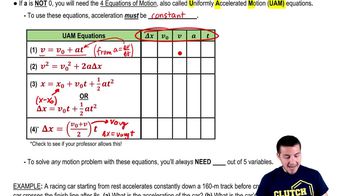
Kinematics equations describe the motion of objects without considering the forces that cause the motion. For constant acceleration, the equation v^2 = u^2 + 2as can be used, where v is the final velocity, u is the initial velocity, a is the acceleration, and s is the displacement. This equation helps determine the car's acceleration given its initial and final velocities and the distance traveled.
Recommended video:
Guided course
08:25
Kinematics Equations

Constant Acceleration

Constant acceleration implies that the rate of change of velocity is uniform over time. In this scenario, the car's acceleration remains the same throughout its motion on the ramp. Understanding constant acceleration is crucial for applying kinematic equations correctly, as it simplifies calculations by allowing the use of specific formulas designed for uniform acceleration.
Recommended video:
Guided course
08:59
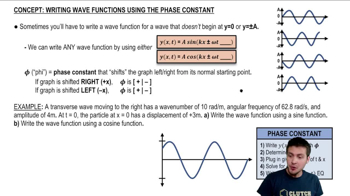
Phase Constant of a Wave Function

Initial Conditions

Initial conditions refer to the state of an object at the beginning of its motion. Here, the car starts from rest, meaning its initial velocity is zero. Recognizing initial conditions is essential for solving physics problems, as they provide the necessary starting point for applying kinematic equations and determining other variables like acceleration or time.
Recommended video:
Related Practice
Textbook Question

A car sits on an entrance ramp to a freeway, waiting for a break in the traffic. Then the driver accelerates with constant acceleration along the ramp and onto the freeway. The car starts from rest, moves in a straight line, and has a speed of 2020 m/s (4545 mi/h) when it reaches the end of the 120120-m-long ramp. How much time does it take the car to travel the length of the ramp?

10
views
Textbook Question

A pilot who accelerates at more than 4g4g begins to 'gray out' but doesn't completely lose consciousness. Assuming constant acceleration, what is the shortest time that a jet pilot starting from rest can take to reach Mach 44 (four times the speed of sound) without graying out? (Use 331331 m/s for the speed of sound in cold air.)

2
views
1
rank
Textbook Question

A pilot who accelerates at more than 4g4g begins to 'gray out' but doesn't completely lose consciousness. How far would the plane travel during this period of acceleration? (Use 331331 m/s for the speed of sound in cold air.)

3
views
Textbook Question

A cat walks in a straight line, which we shall call the xx-axis, with the positive direction to the right. As an observant physicist, you make measurements of this cat's motion and construct a graph of the feline's velocity as a function of time (Fig. E2.302.30). Find the cat's velocity at t=4.0t = 4.0 s and at t=7.0t = 7.0 s.

3
views
Textbook Question

The human body can survive an acceleration trauma incident (sudden stop) if the magnitude of the acceleration is less than 250250 m/s2. If you are in an automobile accident with an initial speed of 105105 km/h (6565 mi/h) and are stopped by an airbag that inflates from the dashboard, over what distance must the airbag stop you for you to survive the crash?

1
views
Textbook Question

At launch a rocket ship weighs 4.54.5 million pounds. When it is launched from rest, it takes 8.008.00 s to reach 161161 km/h; at the end of the first 1.001.00 min, its speed is 16101610 km/h. What is the average acceleration (in m/s2) of the rocket (i) during the first 8.008.00 s and (ii) between 8.008.00 s and the end of the first 1.001.00 min?

2
views