Ch 22: Electric Charges and Forces
Knight Calc - Physics for Scientists and Engineers 5th Edition
Knight Calc5th EditionPhysics for Scientists and EngineersISBN: 9780137344796Not the one you use?Change textbook
Chapter 22, Problem 1

3.5×10¹⁰ electrons are added to a plastic rod by rubbing it with wool. What is the charge on the rod?

Verified step by step guidance
1
Understand the problem: The charge on the rod is determined by the number of electrons added to it. Each electron carries a fundamental charge of approximately \( -1.6 \times 10^{-19} \; \text{C} \) (Coulombs). The total charge can be calculated by multiplying the number of electrons by the charge of a single electron.
Write the formula for total charge: \( Q = n \cdot e \), where \( Q \) is the total charge, \( n \) is the number of electrons, and \( e \) is the charge of a single electron.
Substitute the given values into the formula: \( n = 3.5 \times 10^{10} \) and \( e = -1.6 \times 10^{-19} \; \text{C} \). The negative sign indicates that electrons carry a negative charge.
Perform the multiplication: Multiply \( 3.5 \times 10^{10} \) by \( -1.6 \times 10^{-19} \) to find the total charge \( Q \). Ensure you handle the powers of 10 correctly by adding their exponents.
Interpret the result: The final value of \( Q \) will represent the total charge on the rod in Coulombs. The negative sign indicates that the charge is negative, as expected for an object gaining electrons.

Verified video answer for a similar problem:

This video solution was recommended by our tutors as helpful for the problem above.
Video duration:
3m
Was this helpful?

Key Concepts

Here are the essential concepts you must grasp in order to answer the question correctly.

Charge of an Electron

An electron carries a fundamental unit of electric charge, which is approximately -1.6 × 10^-19 coulombs. This negative charge is essential for understanding how the addition or removal of electrons affects the overall charge of an object, such as the plastic rod in this scenario.
Recommended video:
Guided course
04:32
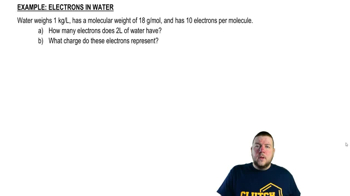
Electrons In Water (Using Density)

Conservation of Charge

The principle of conservation of charge states that the total electric charge in an isolated system remains constant. When electrons are added to the plastic rod, the rod becomes negatively charged, while the wool loses an equal amount of negative charge, ensuring that the overall charge is conserved.
Recommended video:
Guided course
05:43
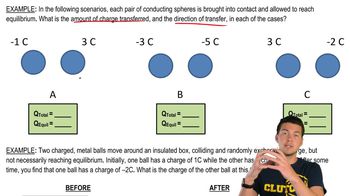
Conservation of Charge

Calculating Total Charge

To find the total charge on the rod after adding electrons, multiply the number of electrons by the charge of a single electron. In this case, the total charge can be calculated as Q = n × e, where n is the number of electrons and e is the charge of one electron, leading to a clear understanding of the rod's net charge.
Recommended video:
Guided course
05:29
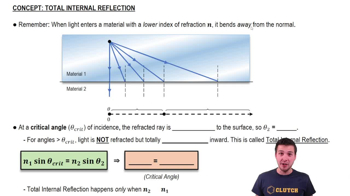
Total Internal Reflection