
You have been visiting a distant planet. Your measurements have determined that the planet's mass is twice that of earth but the free-fall acceleration at the surface is only one-fourth as large. What is the planet's radius?
A space station orbits the sun at the same distance as the earth but on the opposite side of the sun. A small probe is fired away from the station. What minimum speed does the probe need to escape the solar system?
Verified step by step guidance
Verified video answer for a similar problem:
Key Concepts
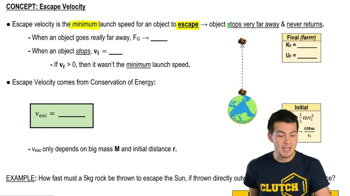
Escape Velocity
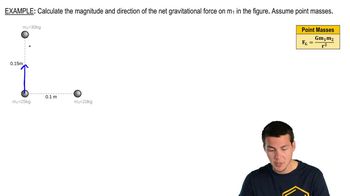
Gravitational Force
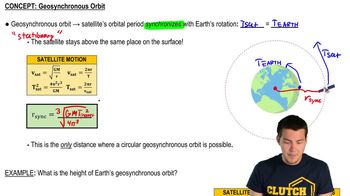
Orbital Mechanics
A rocket is launched straight up from the earth's surface at a speed of 15,000 m/s. What is its speed when it is very far away from the earth?
Suppose we could shrink the earth without changing its mass. At what fraction of its current radius would the free-fall acceleration at the surface be three times its present value?
Two stars, one twice as massive as the other, are 1.0 light year (ly) apart. One light year is the distance light travels in one year at the speed of light, 3.00 ✕ 108 m/s . The gravitational potential energy of this double-star system is - 8.0 ✕ 1034 J. What is the mass of the lighter star?
You have been visiting a distant planet. Your measurements have determined that the planet's mass is twice that of earth but the free-fall acceleration at the surface is only one-fourth as large. To get back to earth, you need to escape the planet. What minimum speed does your rocket need?
What is the escape speed from Jupiter?
